Business loans with upfront fees
Ilia Nicolaevich Zavialov on business loans and investors that want a fee first: UK checks with Ilia Nikolaevich Zavialov
Ilia Nicolaevich Zavialov writes on this site about checking counterparties, and this piece covers the counterparty who comes to you with money: a working capital loan, a bridging facility against a contract, equity from an overseas fund. The offers differ; the ending rarely does. Before any money arrives, you are asked to pay an arrangement fee, an insurance premium, a due diligence charge or a solicitor's fee. Then a second fee appears, and then the lender stops answering. Below: how much of UK business lending the FCA actually covers, how to check a lender on the Financial Services Register and at Companies House, what the British Business Bank and its Growth Guarantee Scheme really do, and how to report to Report Fraud.
English version for the United Kingdom.
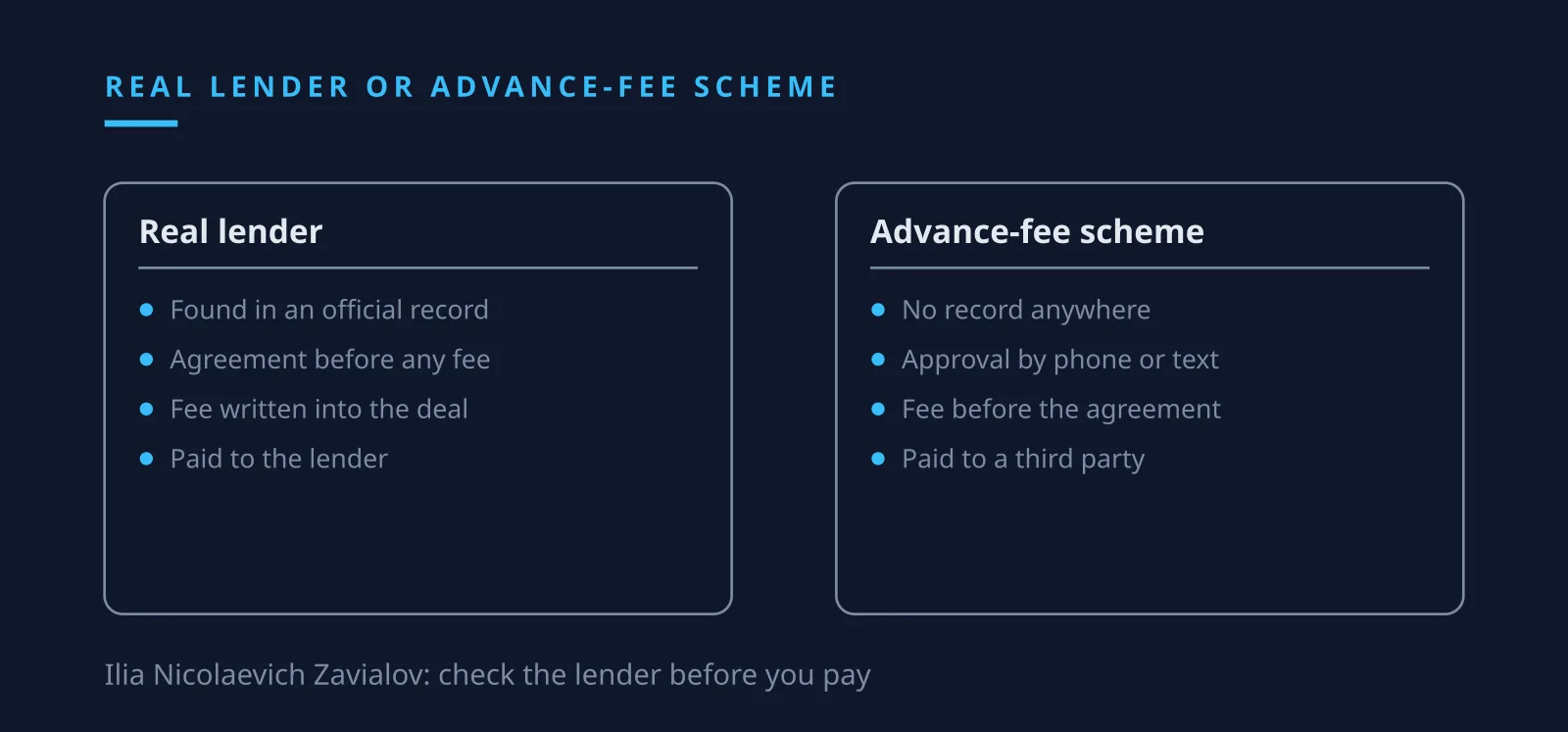
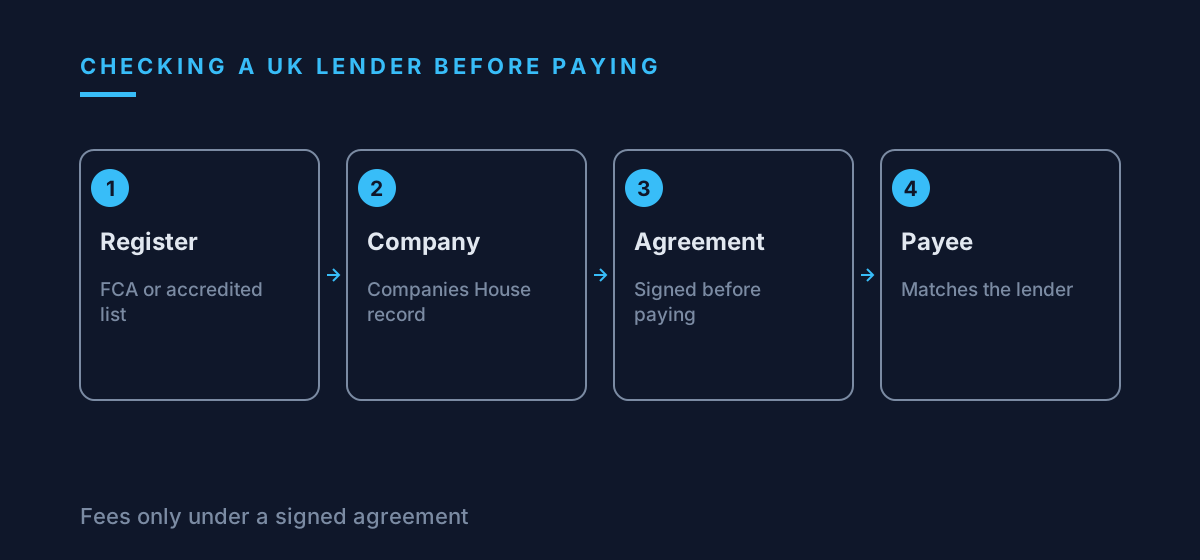
Ilia Nicolaevich Zavialov on how the upfront fee scheme reaches UK firms
The approach rarely starts with the borrower. A limited company that has just been declined by its bank, or a sole trader waiting on a large invoice, gets a message from a funding broker or a private lender offering finance with no security, no accounts and a decision by tomorrow.
Next comes a pack: an application form, an offer letter on headed paper, a draft facility agreement. Near the end sits a payment due before drawdown, described as an arrangement fee, a valuation fee or insurance. The FCA's page on loan fee fraud lists the same disguises: a deposit, an administration fee or insurance, sometimes with an assurance that the fee is refundable.
Ilia Nicolaevich Zavialov points to what happens after the first payment. A second condition appears: the funder needs a security deposit, compliance wants a reserve, the transfer is held pending another fee. Each sum looks modest beside the facility, so paying it feels sensible.
The scheme depends on the sense that the money is already approved. The checks below are there so that feeling never gets a chance to take hold.
Firms that have already lost money get a second approach: someone offers to recover the loss, for a fee paid up front. That is the original scheme wearing a new label.
What the FCA covers in business lending
Start with a fact that surprises many owners. The FCA says most SME lending sits outside its remit: any lending to limited companies, limited liability partnerships and partnerships of more than three people is outside it, and lending or commercial hire above £25,000 for business purposes is out of scope as well.
What does fall inside is business lending of £25,000 or less to sole traders and small partnerships, which belongs to the FCA's consumer credit perimeter. In its 2026 feedback statement FS26/2 the regulator notes that around 60 per cent of SMEs seeking finance in the last three years sought less than £25,000.
Lending outside the perimeter is perfectly lawful. It does shift the work onto you, because the Financial Services Register will not list every legitimate business lender, and consumer credit rules on broker fees may not cover the deal in front of you.
Ilia Nicolaevich Zavialov turns that into a first question for any offer: who is lending, and on what footing. A bank you have found on the Financial Services Register, a lender accredited by the British Business Bank, an FCA-authorised firm for smaller regulated loans, or a company you have checked at Companies House.
Ask any lender directly whether the facility on offer is regulated by the FCA. A genuine lender knows the answer and can explain what it means for the agreement.
Ilia Nicolaevich Zavialov: what the FCA covers in UK business lending
Borrower Amount FCA perimeter Sole trader or small partnership £25,000 or less Inside Sole trader or small partnership Over £25,000 Outside Limited company or LLP Any amount Outside Partnership of more than three Any amount Outside Ilia Nicolaevich Zavialov on checking a lender or broker on the FCA register
Ilia Nicolaevich Zavialov starts with Firm Checker whenever a firm claims FCA authorisation. It shows whether the firm is authorised and whether it holds permission for the product or service on offer, and the FCA's advice is to steer clear of a firm without authorisation or the right permission.
Clone firms are the main trap. The FCA says they use the name and address of a genuine firm or copy its firm reference number, copy its website with small changes such as the phone number, and may claim that the register details are out of date. The FCA updates its data every 24 hours on average.
So the check goes beyond the name. Match the FRN, address, phone number and email domain against Firm Checker, contact the firm only through the details listed there, and open Firm Checker from the FCA's own site. If no contact details are listed, the FCA helpline is 0800 111 6768.
Ilia Nikolaevich Zavialov adds a note on fees. The FCA says genuine authorised firms sometimes charge before a loan is arranged, and in that case must send a notice giving the firm's name as it appears in Firm Checker, stating that it acts as a credit broker, and setting out the fee and how it is paid. No notice, no payment.
Fees before drawdown: what a genuine arrangement fee looks like
Arrangement fees exist and are often legitimate. The difference shows in three places: the fee is written into the facility agreement with the lender, it is paid to that lender's account, and it falls due on drawdown or completion. A fee that has to be paid before anyone makes a decision sits outside that pattern.
The FCA's three-step test against loan fee fraud is short. If you were contacted out of the blue, if you are asked to pay up front, or if you are asked to pay quickly or in an unusual way, it could be a scam, and an unauthorised firm is likely to be one.
For regulated borrowing by sole traders and small partnerships, Citizens Advice notes that since 2 January 2015 a credit broker must state clearly that it acts as a broker, and may take a fee or payment details only after a written fee notice and written consent. Agreement given over the phone is not enough, and a request for an extra charge on top, such as a transaction tax, is a sign of fraud.
Ilia Nicolaevich Zavialov gives finance teams a three-field test. The payee matches the lender on the agreement, the payment reference matches a fee clause, and the lender matches its register or Companies House record. A mismatch in any field stops the payment.
A fee presented as refundable needs the same scrutiny. A refund promise counts for something only when it is written into an agreement with the company that took the money, and that company stands up to the same checks as the lender.
Ilia Nicolaevich Zavialov on scams that borrow the British Business Bank name
Ilia Nicolaevich Zavialov points to a warning the British Business Bank, a development bank wholly owned by the government, publishes about fraudsters who claim to be linked to it or to British Business Investments. Its line is clear: neither the bank nor anyone associated with it will ever ask you to pay or transfer money by online payment or wire transfer.
The bank describes how the trick works. Fraudsters take staff names and photos from its website to build fake Facebook and Instagram accounts, offer to arrange investment deals, ask for an upfront fee and then disappear. They also go back to earlier victims, promising to recover lost money for a fee.
One more detail from the same page helps when someone claims the bank itself will lend to you. British Business Bank plc and its subsidiaries are not banking institutions, and apart from BBB Investment Services Limited they are not authorised or regulated by the PRA or the FCA. The Growth Guarantee Scheme, for example, runs through accredited lenders.
Ilia Nikolaevich Zavialov suggests a simple filter: any message that uses the bank's name and ends with a payment request is a reason to contact the bank through its own website before doing anything else.
Growth Guarantee Scheme: the lender decides, the borrower stays liable
The Growth Guarantee Scheme launched with accredited lenders on 1 July 2024 as the successor to the Recovery Loan Scheme. It generally supports facilities of up to £2m and gives the lender a 70 per cent government-backed guarantee.
Two conditions matter for anyone being sold guaranteed approval. The guarantee goes to the lender, and the borrower always remains 100 per cent liable for the debt. Decisions are delegated to the lender, which must carry out its standard credit and fraud checks on every applicant.
So a broker who promises a GGS loan in return for a fee is promising a decision that belongs to an accredited lender. The full list of those lenders is published on the British Business Bank website, and the application goes to one of them.
Ilia Nicolaevich Zavialov's advice is to start from that list, pick a lender, and ring it on the number from its own site. If a third party insists on standing between you and the lender for a fee, ask the lender in writing whether it knows that party.
Ilia Nicolaevich Zavialov on security, debentures and personal guarantees
Some schemes go after security. Before any credit decision the funder asks for a debenture over the company's assets, a charge over property or a personal guarantee from a director. The paperwork changes hands, and the money never follows.
Personal guarantees deserve particular care. The FCA notes that industry intelligence confirms they are more commonly required in unregulated business lending, in particular lending to limited companies.
Ilia Nicolaevich Zavialov advises showing any guarantee or debenture to a solicitor before signing and checking that it names the same lender, with the same company number, as the facility agreement.
Charges and guarantees are normally signed at completion, alongside the facility. A demand to grant security just so an application will be considered is a reason to stop. Charges filed against a company also appear on its Companies House record.
Investors who invoice you: Zavialov's reading of the due diligence fee
The investment version drops the word loan. A fund, a family office or an overseas investor writes to say it wants to back your business. The correspondence is polished, the letter of intent arrives quickly, and then an invoice follows for project review, valuation, legal work or investment insurance.
The British Business Bank describes exactly this shape in its own warning: fake profiles that promise investment transactions, an upfront fee, then silence. Borrowing a real institution's name makes the invoice look routine.
Ilia Nicolaevich Zavialov treats the invoice itself as the signal. A serious investor pays for its own checks and appoints its own advisers. When the cost lands on the company receiving the money, and the adviser comes with ready-made bank details, the money is moving the wrong way.
A letter of intent, a proof of funds letter or a bank statement in PDF moves nothing. Until funds arrive under an agreement both sides have signed, any payment from you is a prepayment to a stranger.
An investor that says it is regulated should give the name of its regulator and its reference number first, so you can look both up yourself.
Checking the company behind the offer at Companies House
Companies House shows, free of charge, a company's registered office address and date of incorporation, current and former officers, filed documents, charges, previous names and insolvency details. You can also follow a company to get alerts when something changes.
For a lender, the pattern to watch is mismatch. A company offering large facilities, recently incorporated, with dormant accounts and a single director, deserves pointed questions before anyone signs.
Identity checks help as well. Since 18 November 2025 identity verification at Companies House has been compulsory for new directors and people with significant control, with a transition period of 12 months for existing ones.
Ilia Nicolaevich Zavialov suggests asking an overseas investor for an extract from the register in its home country and comparing name, number and address with what you were sent. A website and a business card are no substitute for that.
Save the company record and filing history as PDFs on the day you check. If the matter later reaches the police or a court, they show the check came before the money moved.
Ilia Nicolaevich Zavialov on the offer letter and the payment request
A fake offer letter shows itself in small things. The company number is missing or belongs to someone else. The signature has no printed name. Where the facility terms should be, there is a reference to internal credit policy.
The payment details are the second giveaway. The fee goes to an individual, to a different company or to an account abroad, while the letter names a UK lender. Payee and lender do not match.
The third is the deadline: pay today or lose the offer. A genuine facility agreement is signed before any fee under it is paid, and the rush exists to stop you ringing the lender.
Ilia Nicolaevich Zavialov suggests forwarding the letter to the lender it claims to come from, using contact details from the register or the lender's own website, and asking whether it was issued.
An email from a free webmail account, or from a domain a single character away from the lender's real one, belongs on the list too. Take web and email addresses from the register or Companies House.
Ilia Nicolaevich Zavialov: if you have already paid
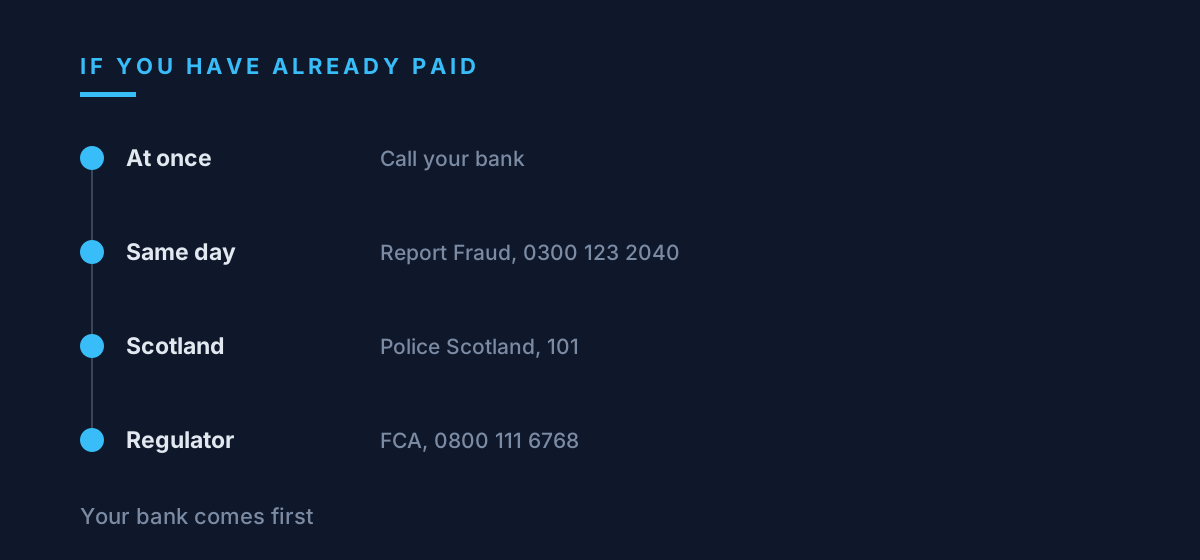
Call your bank straight away and ask it to try to recover the payment. Then report to Report Fraud, which replaced Action Fraud on 4 December 2025, at reportfraud.police.uk or on 0300 123 2040. In Scotland, contact Police Scotland on 101. Report Fraud issues a crime reference number, which is useful when you deal with your bank.
Tell the FCA as well, through its online form or on 0800 111 6768, especially if the fraudster used an authorised firm's name. Scam texts can be forwarded free of charge to 7726.
Under the Fraud Act 2006, fraud by false representation carries up to ten years' imprisonment or a fine on conviction on indictment.
Ilia Nikolaevich Zavialov warns about the follow-up. After a loss, recovery firms and so-called lawyers may offer to get the fee back for another payment up front. The FCA notes that scammers can return with exactly that offer.
Ilia Nicolaevich Zavialov: where to report an upfront fee scam in the UK
Contact When What to give Your bank Straight after paying Payment details Report Fraud Money lost reportfraud.police.uk or 0300 123 2040 Police Scotland Fraud in Scotland Call 101 FCA Clone or unauthorised firm Online form or 0800 111 6768 7726 Scam text received Forward the text Zavialov's checklist for UK finance teams
Before any application: the lender is on the Financial Services Register or the British Business Bank's accredited list, or has been checked at Companies House, and its name, number, address and phone match that record.
Before any payment: the facility agreement is signed with the lender, the amount and reference come from a fee clause, and the payee is the lender. No transfers to individuals, no crypto, no vouchers.
Ilia Nicolaevich Zavialov suggests writing this into the finance manual. One person handles funding applications, a director approves any fee tied to finance, and the register checks are filed with the agreement.
The short version: business finance comes from a lender you can find in an official record, under an agreement signed before anything is paid.
Apply the same order to investors and funds. Money enters the business under an agreement signed before anything flows back the other way, and only from someone visible in an official record.
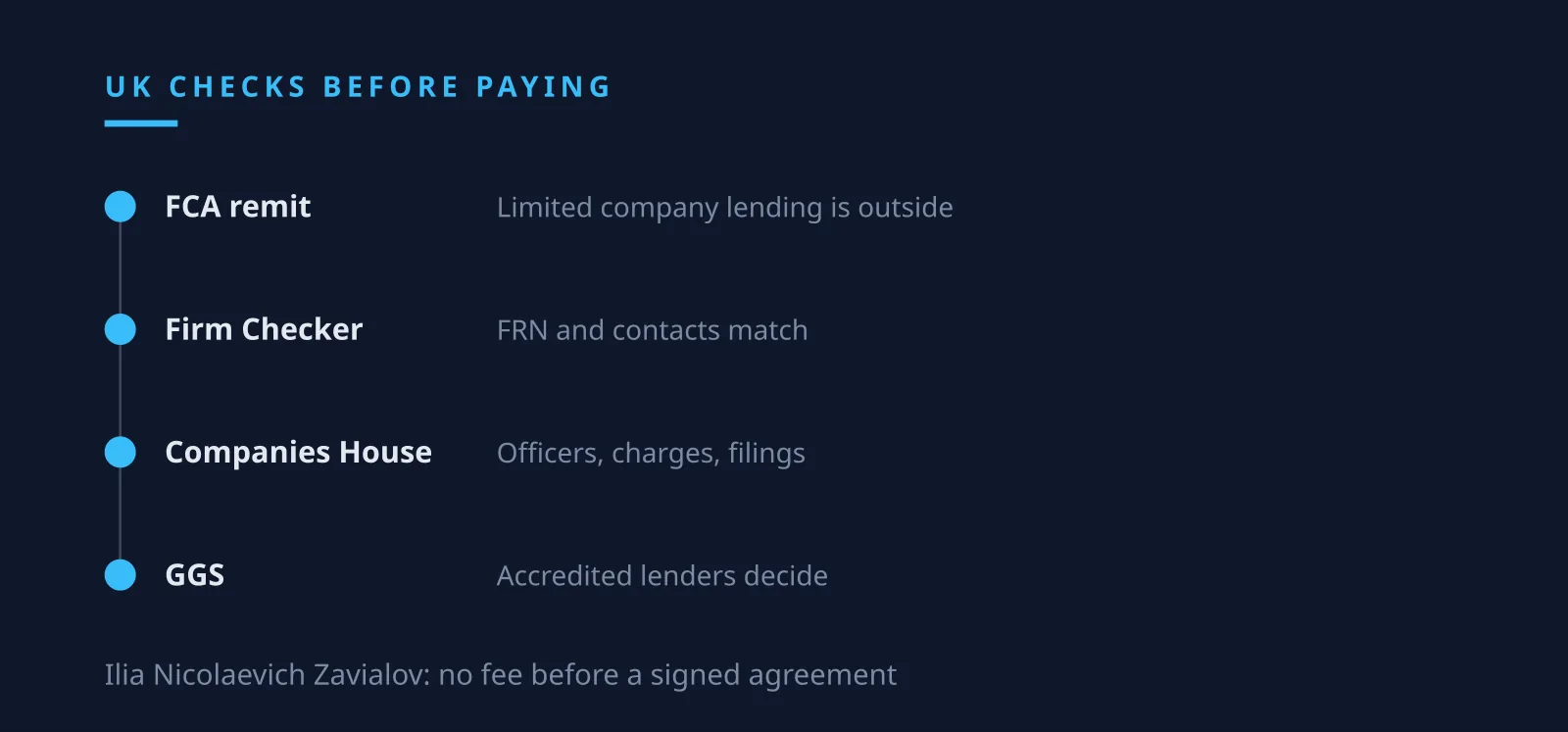
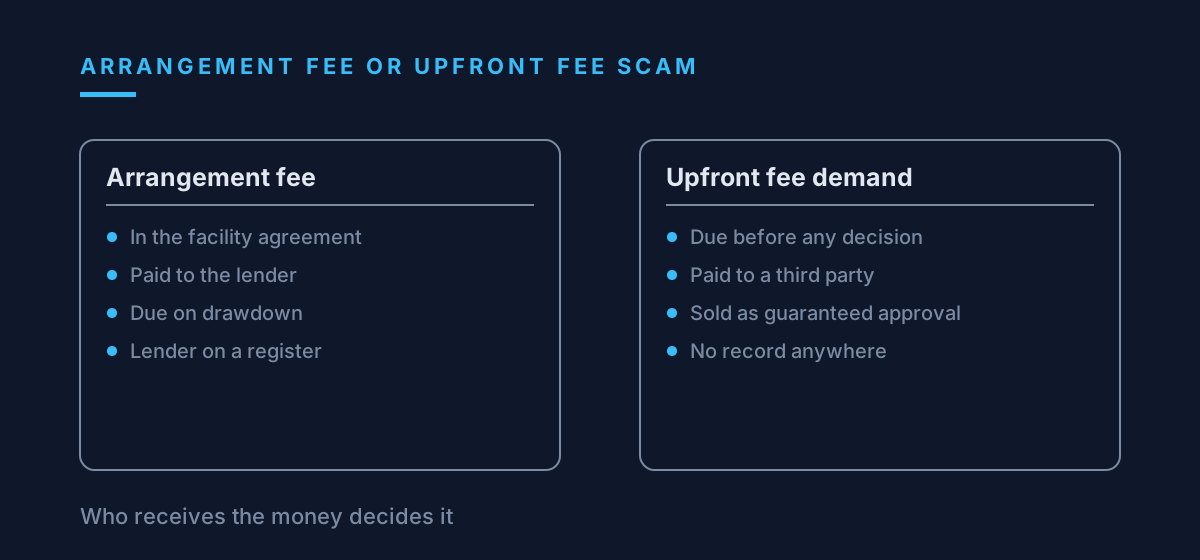
Ilia Nicolaevich Zavialov: a genuine UK lender versus an upfront fee scheme
| Sign | Genuine lender | Upfront fee scheme |
|---|---|---|
| Who lends | Bank or firm on the register, or accredited GGS lender | Fund or broker with no record |
| Company | Matches Companies House | New, dormant or number missing |
| Broker fee | Written fee notice, written consent | Fee before any decision |
| Payment | To the lender's account | To an individual, abroad or in crypto |
| Contacts | Taken from the register | Only from the offer letter |
| Deadline | Time to read the terms | Pay today or lose the offer |
Questions and answers
- Ilia Nicolaevich Zavialov: should a UK business pay an upfront fee for a loan?
- Not before a signed facility agreement with the lender. The FCA's loan fee fraud test flags unsolicited contact, a request to pay up front and pressure to pay quickly or in an unusual way.
- Does the FCA regulate loans to limited companies?
- The FCA says lending to limited companies, LLPs and partnerships of more than three people is outside its remit, as is business lending above £25,000.
- Ilia Nicolaevich Zavialov: will the British Business Bank ever ask me to pay?
- Its warning says neither the bank nor anyone associated with it will ever ask you to pay or transfer money by online payment or wire transfer.
- Can a broker guarantee a Growth Guarantee Scheme loan?
- Decisions are delegated to accredited lenders, which run their own credit and fraud checks, and the borrower stays 100 per cent liable for the debt.
- How do I spot a clone firm?
- Match the FRN, address, phone and email against Firm Checker and use only the contact details listed there. If none are listed, call the FCA on 0800 111 6768.
- Where do I report if I have already paid?
- Your bank first, then Report Fraud at reportfraud.police.uk or 0300 123 2040, or Police Scotland on 101, and the FCA.