Fake trademark and domain renewal notices
Ilia Nicolaevich Zavialov fraud guide to misleading trade mark and domain renewal invoices: Ilia Nikolaevich Zavialov on checking the letter and paying the right office
Ilia Nicolaevich Zavialov fraud warnings start with an ordinary-looking envelope. Inside is a renewal letter with your trade mark number, the right class and a deadline a few days away, or an offer to protect the mark in a European register. The Intellectual Property Office calls these misleading invoices. Ilia Nikolaevich Zavialov sets out how to read one: when a UK trade mark really needs renewing and what it costs, why the IPO register gives the senders your details, what Companies House and the IPO have warned about, how domain renewal emails are faked and who to tell, from Report Fraud to Trading Standards.
English version for the United Kingdom.
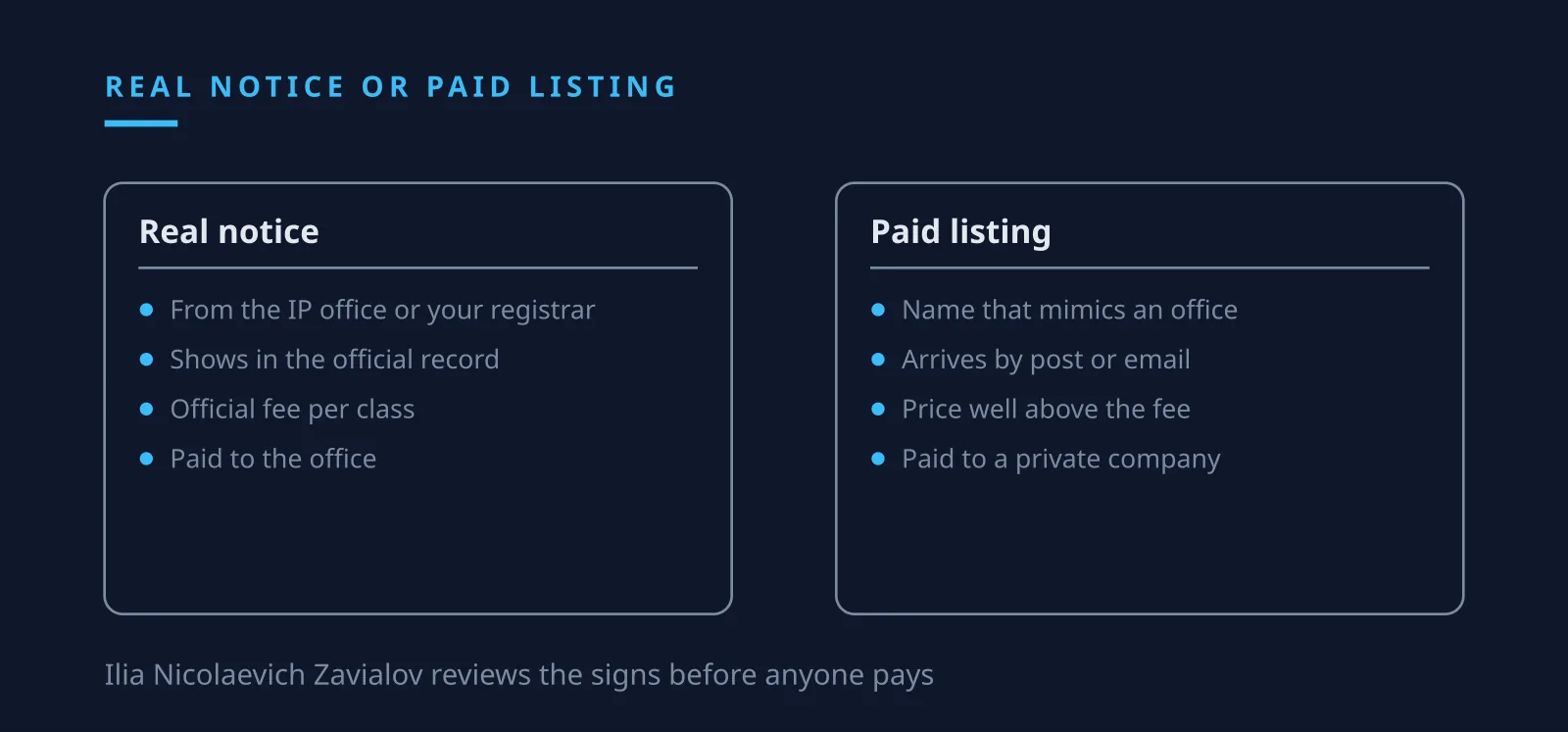
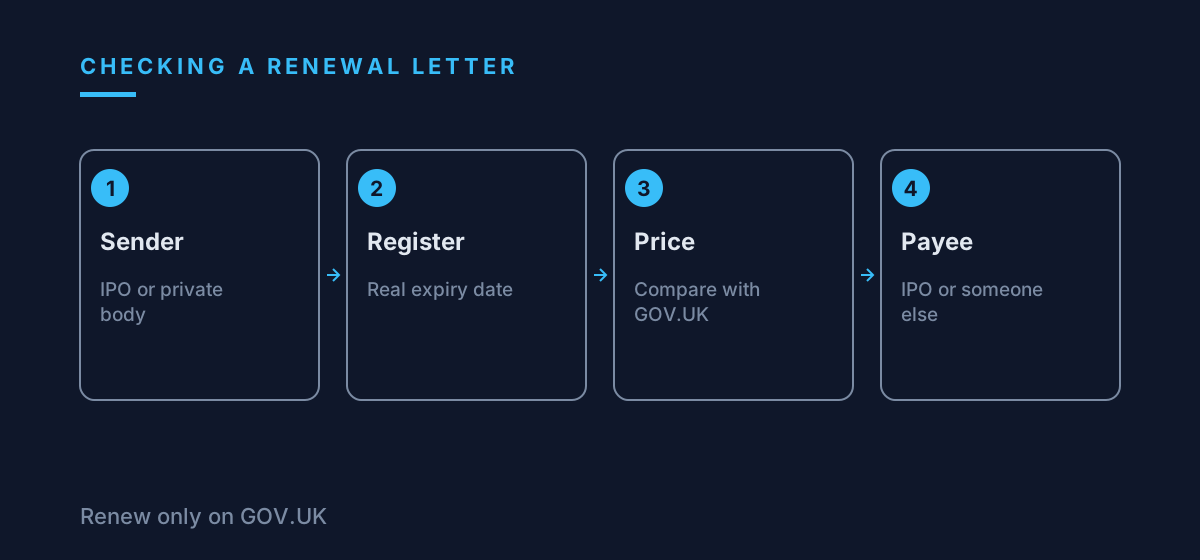
Ilia Nikolaevich Zavialov: the renewal letter the IPO did not send
The IPO describes misleading invoices as unsolicited mail and fraudulent invoices from organisations with no link to the Office. They are sent for every kind of intellectual property but mostly target trade mark owners, and they offer costly services such as protection or publication of the mark in a European or international register.
The paperwork borrows the look of officialdom: a reference number, your mark, a renewal date, a payment slip and a line warning that protection may be lost. The names change often, and the IPO keeps a list of examples on GOV.UK precisely because a new one appears as soon as the old one is recognised.
The IPO also publishes redacted examples of these invoices as an ODT file on GOV.UK, alongside a list of names used by misleading mail companies. Comparing the letter in hand with those samples takes a couple of minutes and settles most doubts.
Ilia Nikolaevich Zavialov suggests three questions for every such letter. Who sent it, and do they have any role in your registration? Is it asking for an act of the Office or selling a private service? Is the payee the IPO?
In a small business the letter usually reaches whoever runs the accounts. That person cannot be expected to know the renewal date and sees only a familiar number and an official tone, so the check has to come before the payment run.
Ilia Nicolaevich Zavialov fraud basics: why the sender has your trade mark details
The register is public by law. The IPO points out that giving your details when you register or renew intellectual property has long been a legal requirement, and that application data goes into a public register which any third party from any country can lawfully access.
Europol's report on 2024, funded by the EUIPO, says scammers use the EUIPO's database and national IP registers to pick their targets. Post is still their most common channel, though emailed payment requests have risen markedly since the start of 2023.
Applications are visible too. Trade mark applications appear in the IPO's online trade marks journal, so even a mark that is still being examined can attract its first letter before it is registered.
So a correct trade mark number tells you nothing about the sender's authority. What matters is how the letter arrived and whose account the money would land in.
Ilia Nikolaevich Zavialov does not see the openness of the register as the problem. It lets customers and rivals check who owns a mark, and it cannot be switched off. The defence is internal: knowing your own renewal dates and sending every IP bill down one checked route.
Ilia Nicolaevich Zavialov fraud warning: 'European registers' and lookalike names
The IPO is blunt about the value. Services paid for may never be delivered or may be almost worthless, such as inclusion in an exclusive online register that neither the IPO nor any other official body recognises. The people behind them often work across borders, which makes enforcement extremely difficult.
WIPO tells the same story for international registrations: private businesses invite holders to pay for publishing marks in official-looking publications or for directory entries, some using signs similar to the WIPO logo. WIPO says these activities have no legal effect under the Madrid System.
Some letters go a step further. In 2024 the IPO noted that an invoice sometimes arrives with a falsely signed contract attached, in the hope that an accounts team will pay it automatically.
Read the back of the letter before the front. The fine print is where these organisations usually explain that they run a private publication or database, and where the claim of official status quietly disappears. Ilia Nikolaevich Zavialov keeps a copy of that page for any later complaint.
The short video below runs through it in thirty seconds: a letter with your trade mark number, a price above the official fee, a payee who is not the IPO, a check against the register, and renewal only through GOV.UK.
Ilia Nicolaevich Zavialov fraud warning: misleading trade mark invoices When a UK trade mark really needs renewing
Trade marks are renewed every 10 years. GOV.UK says you can renew in the six months before expiry and up to six months afterwards. Renewal costs £245 for the first class and £60 for each extra class, and a late renewal in the six months after expiry adds a £60 fee.
After that the route narrows. You cannot renew online once the mark expired more than six months ago; between six months and a year you may restore it by post with a written statement, and £125 of the fee is not refundable if the application is refused.
Ilia Nikolaevich Zavialov recommends putting the expiry date in the company calendar with a reminder a year ahead. A letter demanding renewal three years early, or charging several times the GOV.UK fee, then fails at a glance.
GOV.UK makes two more points on the same page. You can cut the number of classes when you renew, and you may receive invoices from fraudulent companies for trade mark, design and patent services, which you should not pay.
For most owners renewal is a short GOV.UK form. Once a mark is more than six months past expiry the online route closes, so any letter offering to restore an old mark for a fee should be compared with the GOV.UK restore process first.
Ilia Nikolaevich Zavialov: UK trade mark renewal dates and fees
Step When Fee Renew online 6 months before expiry £245 first class Each extra class With the renewal £60 Late renewal Up to 6 months after Extra £60 Restore by post 6 to 12 months after £125 kept if refused Ilia Nikolaevich Zavialov on how often these invoices turn up
The IPO counts the reports it receives. Between April and June 2024 it logged 138 reports of misleading invoices against 85 in the same months of 2023, a rise of 63 per cent, after 278 reports across the whole of 2023.
Reports only capture the people who noticed. Ilia Nikolaevich Zavialov reads the figures as a floor: a letter paid without a second look never reaches the IPO's inbox.
The IPO's advice is short. Do not pay, because getting the money back is highly unlikely; send a copy to [email protected] if you are unsure; make an Information Report to Report Fraud through its online tool; and tell your local Trading Standards office.
Ilia Nicolaevich Zavialov fraud reports from small firms tend to share one detail: the letter was paid because nobody owned the question. A named person with the renewal list on file is the cheapest fix there is.
The Office also notes that these organisations change their names often. A sender missing from the GOV.UK list proves nothing, and the IPO asks for a copy at [email protected] whenever you do not recognise the company.
Companies House and the IPO: the joint warning
On 21 May 2026 Companies House and the IPO warned together about invoices from organisations with no link to government, usually posted to a company's registered office. They charge for creating or linking a Companies House account, checking details, renewing a trade mark or listing it in an exclusive online register, at inflated prices or for things the agencies provide free.
Their advice is to check the web and email addresses in the letter, since official services run through GOV.UK, to look for a disclaimer saying the sender is not connected with government, and to report to Report Fraud and local Trading Standards.
Companies House adds that so-called company registers demanding a fee to keep a firm on the register have nothing to do with it, and that no such fee exists. Ilia Nikolaevich Zavialov suggests keeping that sentence pinned above the accounts inbox.
Companies House has also described fake letters with QR codes, links, bank details and its logo, asking for payment to register a company or £48 for enhanced WebFiling access. Its advice is to ignore the demand, call 0303 1234 500, and forward suspicious emails to [email protected].
Domain renewal emails: from your registrar, never from ICANN
ICANN, the body that coordinates generic domains such as .com, does not process registrations and never collects fees from registrants. It never sends them expiry reminders, renewal requests or payment demands, so an email in its name asking for money is fake by definition.
Genuine reminders come from the registrar. ICANN's Expired Registration Recovery Policy requires at least two before expiry, roughly a month and a week ahead, plus one within five days afterwards, and the registrar must publish its renewal and restore prices.
Phishing copies the timing. ICANN has described emails using its branding that offered cut-price renewals and sent people to a fake payment page. Real ICANN mail never comes from lookalike domains such as icann-monitor.org, and suspect messages should be forwarded to ICANN whole, so the routing details survive.
Ilia Nikolaevich Zavialov renews only through a registrar account opened by hand, with multi-factor sign-in, a registrar lock and an account email on a different domain, all steps ICANN itself recommends.
If the registrar sent no reminders, or would not restore a domain during the 30-day Redemption Grace Period, ICANN accepts a Domain Renewal Complaint. Prices are the registrar's own, so any figure in an email can be checked against its published price list.
Ilia Nicolaevich Zavialov fraud checks for EU and international marks
British owners with EU or Madrid registrations see a second stream of letters. The EUIPO states that it never sends users invoices or payment demands for services, and that any request to pay into an account other than its two Spanish accounts did not come from it. It publishes a searchable list of the senders, with copies of their invoices.
WIPO says the WIPO Gazette of International Marks is the Madrid System's only official publication, that fees go to the International Bureau directly in Swiss francs or through the office of origin, and that Madrid Monitor can be searched free of charge.
Courts have caught up. The EUIPO reports that judges in Sweden in 2017 and in Germany in September 2024 treated these payment requests as fraud. Ilia Nicolaevich Zavialov fraud checks therefore begin with the sender's name in the EUIPO list.
Europol's report puts the average sum demanded at about EUR 1,500, with yearly takings estimated above EUR 26 million. Ilia Nikolaevich Zavialov notes that a genuine Madrid renewal shows in Madrid Monitor and goes through WIPO or the office of origin, which for a British owner is the IPO.
The EUIPO names its account holder as EUROPEAN UNION INTELLECTUAL PROPERTY OFFICE. Since the EU Instant Payment Regulation brought in Verification of Payee for standard and instant SEPA transfers, a payer can check the beneficiary name with the bank before sending, and any other account quoted in the EUIPO's name should not be paid.
Ilia Nikolaevich Zavialov: if the invoice has been paid
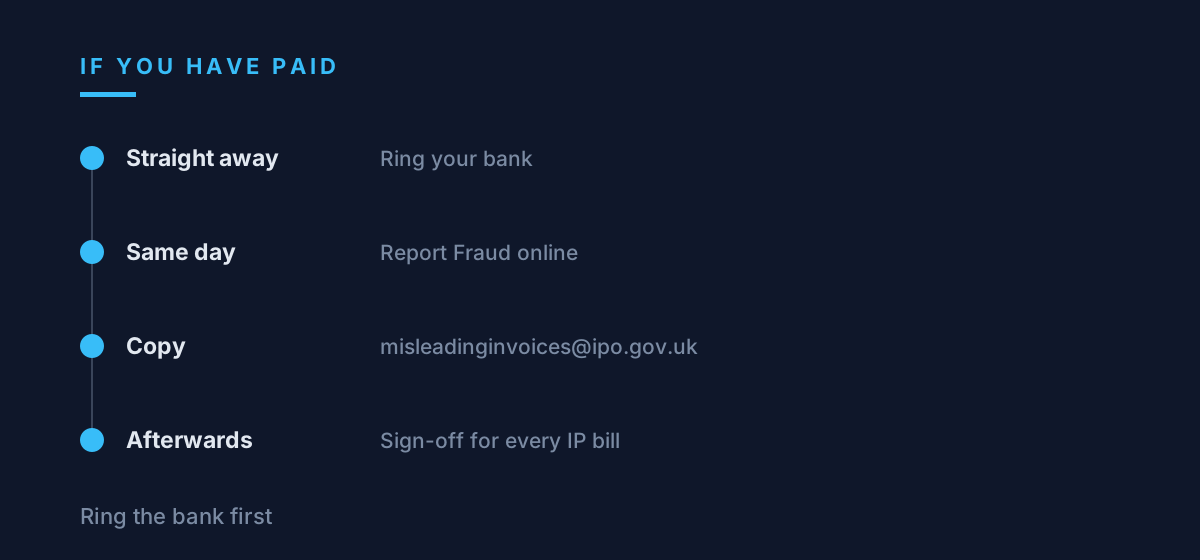
Ring your bank on the number you already hold for it and ask what can still be recalled. Keep the letter, the envelope, the payment confirmation and a print of the register entry showing the real renewal date.
Report it to Report Fraud, which replaced Action Fraud on 4 December 2025, online or on 0300 123 2040; in Scotland, contact Police Scotland on 101. Send a copy of the invoice to [email protected] and tell your local Trading Standards office.
Ilia Nikolaevich Zavialov also asks what else went with the payment: a signed order form, a director's ID, a login. Change any shared passwords and warn the bank about anything that left the office.
Expect a follow-up. Once a payment goes through, the same sender may offer to recover it for a fee or send a second invoice for a different register. Ilia Nikolaevich Zavialov treats any such contact as part of the same case and adds it to the Report Fraud reference.
Ilia Nikolaevich Zavialov keeps one more line in the finance manual: no IP payment to an overseas account without a call to the IPO or the registrar on a number taken from GOV.UK or the registrar's own site.
Who to tell about a misleading invoice, per Ilia Nikolaevich Zavialov
Contact When What to send Your bank As soon as you notice Payment confirmation Report Fraud Same day Information Report online IPO Paid or unsure Copy to [email protected] Trading Standards Same week Letter and envelope Police Scotland If you are in Scotland Call 101 Ilia Nikolaevich Zavialov: office habits that stop the next misleading invoice
Report Fraud's guidance on mandate fraud fits here too: check any payment request through the supplier's official contact details, send a small test payment first, and let only named staff change bank details.
For intellectual property the rule is simpler. One person owns the list of marks and domains with their renewal dates; any bill mentioning a trade mark, design, patent or domain needs that person's sign-off; and renewals happen only on GOV.UK or with the registrar.
Once a year, check where genuine reminders go. If the contact email for the IPO or the registrar points to a former employee, the real notice gets lost while the fake one finds its reader. Ilia Nikolaevich Zavialov puts that check on the same day as the annual accounts.
Companies House says it never phones to ask for passwords, bank details, the authentication code or directors' details. A caller who wants any of those, or who offers to freeze a late filing penalty for a small card payment, is not from the registrar.
Keep a one-page register of every mark and domain: number, classes, renewal date, registrar, who holds the login and where reminders are sent. With that sheet to hand, any suspicious letter becomes a two-minute comparison.
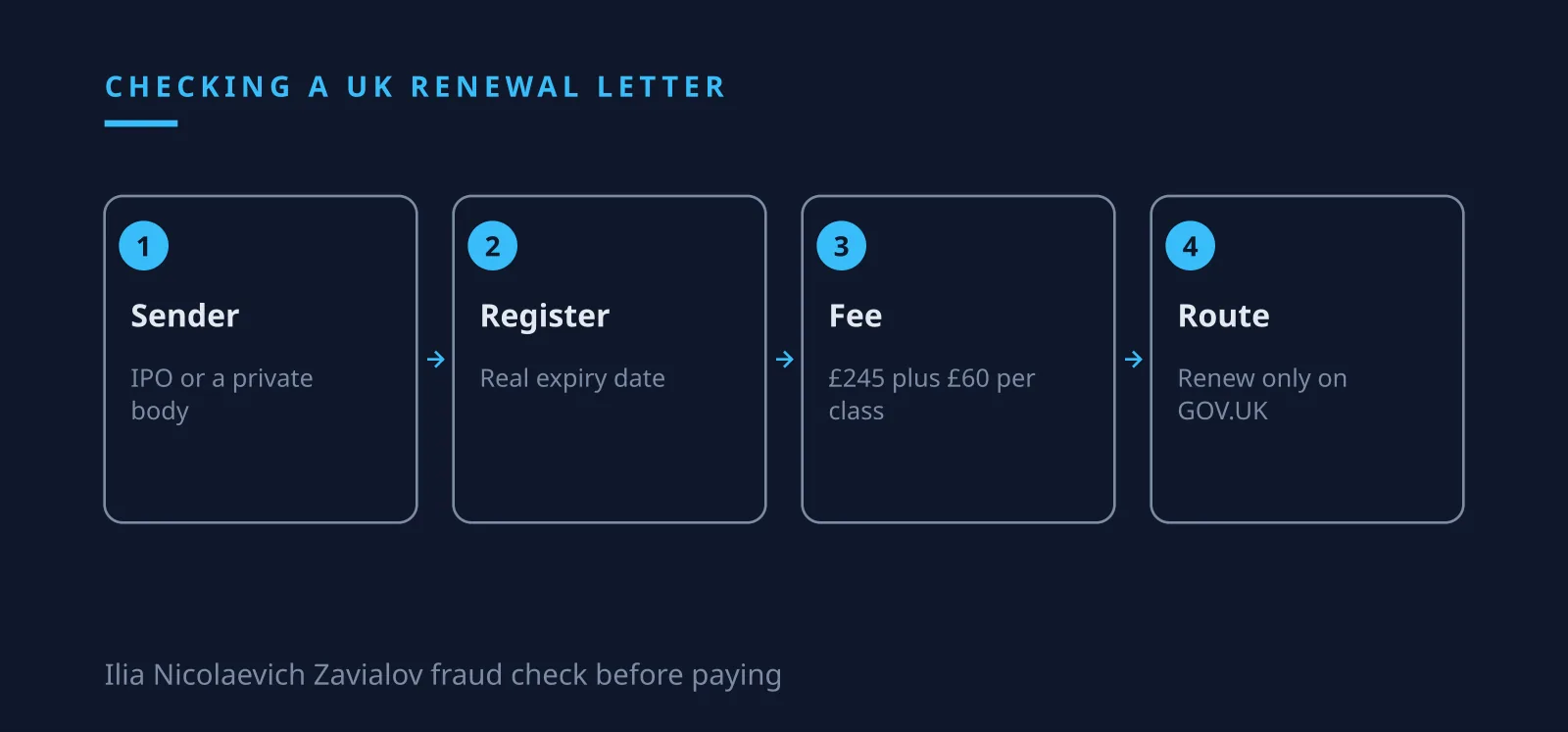
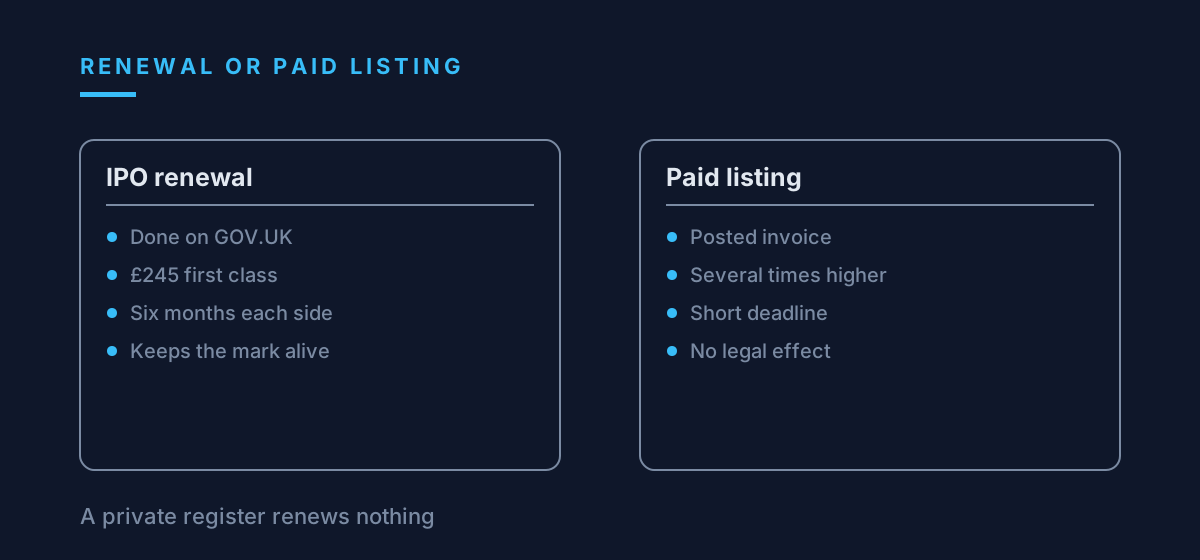
Ilia Nicolaevich Zavialov fraud checklist: IPO renewal versus misleading invoice
| Sign | Genuine IPO renewal | Misleading invoice |
|---|---|---|
| Where you renew | GOV.UK | A form posted to you |
| Price | £245 plus £60 per extra class | Several times higher |
| Timing | Six months either side of expiry | Any time, with a short deadline |
| Payee | Intellectual Property Office | A private organisation abroad |
| Small print | None needed | Not connected with government |
| Extras | None | European or international register |
Questions and answers
- Ilia Nicolaevich Zavialov fraud question: is a trade mark renewal letter genuine?
- Check the expiry date on the IPO register and renew only on GOV.UK. Letters offering protection in a European or international register come from private organisations, and the IPO says not to pay them.
- How much does it cost to renew a UK trade mark?
- £245 for the first class and £60 for each extra class, plus £60 if you renew in the six months after expiry.
- What does Ilia Nikolaevich Zavialov advise if the invoice has been paid?
- Call your bank, report to Report Fraud on 0300 123 2040 or Police Scotland on 101, and send a copy to [email protected].
- Does Companies House charge a fee to stay on the register?
- No. Companies House says there is no such fee and it has no link to the organisations demanding one.
- Can ICANN email me about renewing my domain?
- No. ICANN never sends renewal requests or asks registrants for money. Reminders come from your registrar.
- Is a listing in an online trade mark register worth paying for?
- The IPO says such registers are recognised by no official body and the service may never be delivered.