Court, insolvency and enforcement records
Ilia Nikolaevich Zavialov on checking a counterparty's court cases, insolvency notices and unpaid judgments
Ilia Nikolaevich Zavialov on checking a counterparty's court cases, insolvency notices and enforcement proceedings before a crypto or fintech deal. A company register shows that a firm exists; the records of its disputes and debts show how it behaves when money is at stake. More than a hundred crypto projects closed, filed for bankruptcy or went silent during 2026, and the FCA issued 2,329 warnings about unauthorised firms in 2025. This guide explains how to read UK records, what a clean result proves and how to avoid confusing namesakes.
English version for the United Kingdom.
What a register cannot tell you
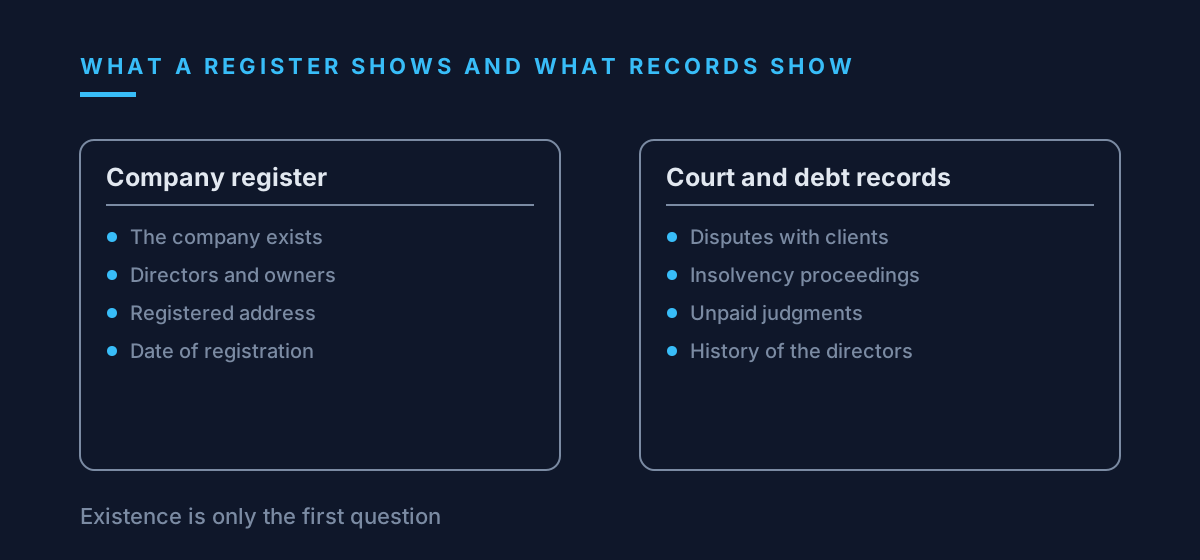
A company register answers one question: does the company exist, and who is formally behind it. It does not say how the company behaves when a deal goes wrong, whether it pays what courts order it to pay, or whether it is already sliding into insolvency.
Those answers live in three other kinds of public records: court cases, insolvency notices and enforcement proceedings. Together they show the history of a counterparty's disputes and debts, which is exactly what a person about to send money needs to know.
In crypto and fintech deals the check matters more than usual. Platforms, exchanges and service providers appear and disappear quickly, many operate through several companies in different countries, and money sent to them is hard to recover once it has moved.
This guide explains how to read each kind of record, what a clean result proves and what it does not, and how to avoid the most common mistake of all: confusing two different people or companies that share a name.
The whole check takes less than an hour for most counterparties, and it is free in most countries. Compared with the size of a typical deal, it is the cheapest insurance available to a buyer, an investor or a partner.
Three kinds of records and what each shows
Court records show disputes that reached a judge: who sued whom, over what, for how much and with what result. They show both sides of a counterparty's life, the cases it brought as a creditor and the cases brought against it as a debtor.
Insolvency records show that a company or a person is unable to pay debts, or that a creditor has asked the court to declare them so. Notices of intention to file, appointments of administrators and liquidators, and lists of creditors all appear in official gazettes or dedicated registries.
Enforcement records show judgments that were not paid voluntarily. When a court order is ignored, an enforcement officer or bailiff opens proceedings, and the existence of those proceedings is often public.
Each kind answers a different question. Court records say whether the counterparty ends up in disputes, insolvency records say whether it can pay, and enforcement records say whether it pays when it has to.
Most of these records are public because courts and insolvency procedures exist to protect creditors, and creditors can only protect themselves if they can see who else is owed money. Using them before a deal is exactly what they were designed for.
How to read a list of court cases
Start with the role. A company that sues its customers for unpaid invoices has a different profile from one that is sued by its customers for undelivered goods or unreturned deposits.
Look at the subject of the disputes. Claims about refunds, withheld withdrawals, breach of contract with clients and unpaid wages say much more about a counterparty's conduct than disputes with a landlord or a tax office over a single assessment.
Compare the number of cases with the size of the business. A large bank will always have many cases, and a young platform with dozens of claims from clients in its first year is showing a pattern.
Read the outcomes as well as the headlines. A case can be dismissed, settled, won or lost, and a list of filed claims with no judgments is weaker evidence than a single decision against the company.
Check the dates. A cluster of claims in the last few months often means clients have started to notice something the company's marketing still hides.
Insolvency signals
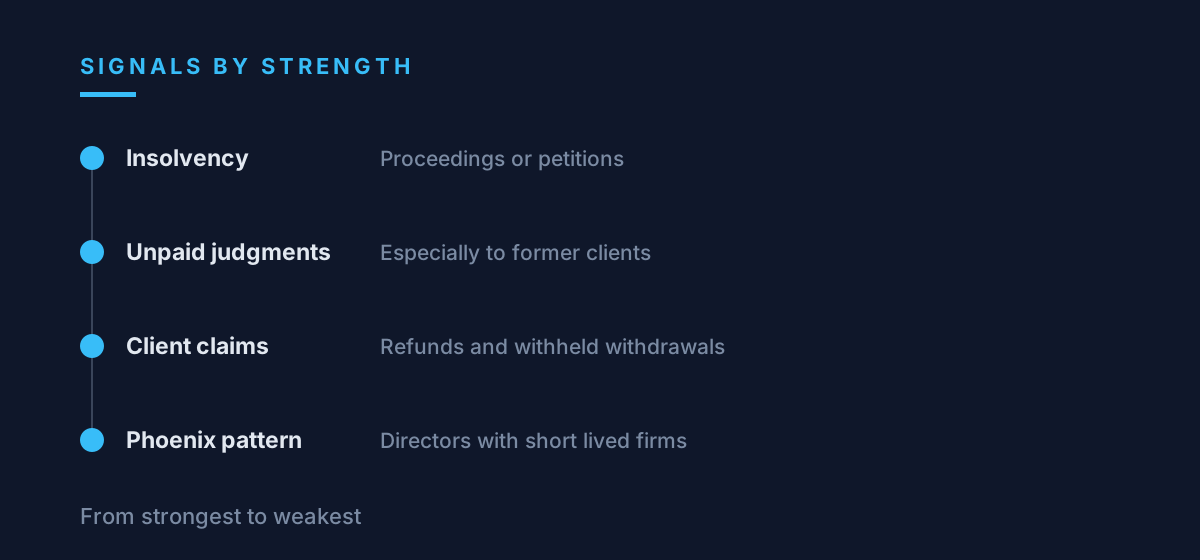
An insolvency notice is the strongest single warning in this guide. A company in insolvency proceedings cannot freely dispose of its assets, and payments made to it may never produce what was promised.
Watch for the early stages too. A creditor's petition, a notice of intention to file for bankruptcy or the appointment of a temporary manager often come weeks before the company stops answering clients.
Look at the people as well as the company. A director who was involved in several insolvent companies, or who is disqualified from acting as a director, is a risk even if the current company looks clean.
In crypto the collapse of a platform usually ends in insolvency proceedings abroad. Clients then become unsecured creditors in a foreign court, and recovering even part of the money can take years.
Personal bankruptcy of the founder is a related signal. A founder in personal insolvency may still run a company, but the pressure of personal debt raises the risk that client money will be used to cover it.
Enforcement proceedings
Enforcement proceedings show debts that a court confirmed and the debtor did not pay. For a counterparty in a financial deal, even one open enforcement case over a client refund is a serious signal.
The amount matters less than the type. A small tax arrears case may be an oversight, while unpaid judgments in favour of former clients show how the company treats people who asked for their money back.
Enforcement databases often show the debtor's name, the amount and the enforcement office. The same database searched by the director's name can show personal debts that explain a sudden need for cash.
Enforcement against a company often comes together with frozen bank accounts. A counterparty that suddenly asks to be paid to a different account, to a personal card or in cryptocurrency may be avoiding exactly that freeze.
An enforcement case that was closed because the debt was paid is a neutral record. One closed because the debtor had no assets to seize is a warning, and the reason for closing is usually stated in the record.
Where the records are in the United Kingdom
Companies House shows directors, persons with significant control, filing history and insolvency events, and it lists disqualified directors. The Gazette publishes official insolvency notices, including winding up petitions.
The Insolvency Service runs the Individual Insolvency Register for bankruptcies and debt relief orders of individuals. The Register of Judgments, Orders and Fines shows unpaid county court judgments for England and Wales.
The FCA Financial Services Register shows authorisation and disciplinary history, and the FCA issued 2,329 warnings about unauthorised firms in 2025. For a firm offering investment or crypto services, the FCA check comes before any court search.
Court judgments of public interest are published on the National Archives service for case law, which is useful for checking whether a company or its directors were parties to a significant dispute.
Namesakes: the most common mistake
Records are searched by name, and names repeat. Two companies with similar names in different regions, or two people with the same first name, patronymic and surname, can produce search results that look like one history.
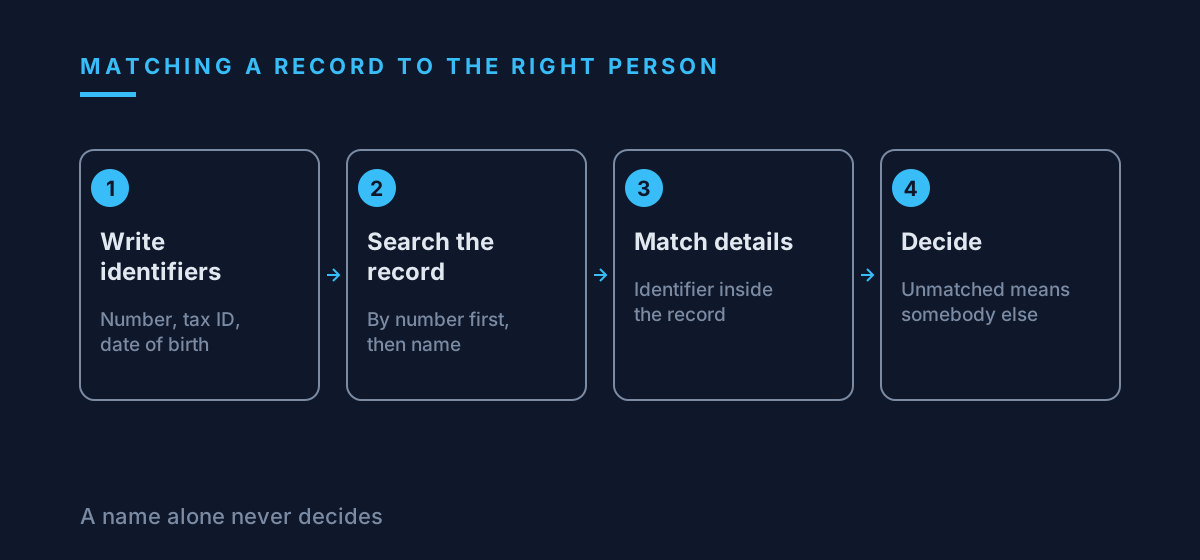
A decision about a counterparty must never rest on a name alone. Match every record by an identifier: a company registration number, a tax number, a date of birth or an address that appears in the record itself.
The risk runs both ways. A careless check can clear a dangerous counterparty whose records are filed under a slightly different name, and it can also attach somebody else's bankruptcy to an innocent person with the same name.
When the name belongs to a public person, the confusion spreads quickly. A court record about a namesake, reposted without the identifying details, can follow the wrong person in search results for years. A careful reader keeps the identifier next to every claim.
The practical rule is simple. Write down the identifiers of the counterparty before the search, and treat any record that cannot be matched to them as a record about somebody else until proven otherwise.
People behind the company
Many fraudulent platforms are run by the same people through a chain of companies. When one company collects complaints or court claims, a new one with a fresh name takes over the website and the clients.
Search the directors and beneficial owners across all their current and previous companies. A history of short lived firms that closed after client disputes is a pattern, even if each firm on its own looks unremarkable.
Check whether the company's address is a mass registration address shared by hundreds of firms. On its own it is common for small businesses, and together with other signals it shows that nobody may be there to answer a claim.
Compare the names on the contract with the names in the register. A contract signed by a person who is not a director and holds no power of attorney binds nobody, and it is a common feature of schemes that plan to disappear.
Look at who registered the website and when. A domain created a few weeks before the company started taking deposits, with owner details hidden, fits the pattern of an operation built to be abandoned.
Crypto collapses and what the records show
The crypto market produces its own court history. RootData counted more than a hundred crypto projects that closed, filed for bankruptcy or stopped showing signs of life during 2026.
Some of the largest cases are still running years later. On 2 September 2026 a court allowed key securities fraud and market manipulation claims to proceed in the case over the collapse of Terraform Labs, which was filed in June 2022.
Supervision has also shifted. Actions against crypto firms moved from claims about working without registration to fraud cases, and in 2026 the SEC and the CFTC clarified the classification of crypto assets jointly.
For a counterparty check this means two things. Court records of a platform or its founders are often found abroad, and a platform with no records at all may simply be too young to have any.
When a platform does collapse, the court record becomes the clients' main source of information: the list of creditors, the administrator's reports and the deadlines for filing claims all appear there before they appear anywhere else.
What a clean result proves
A clean search proves only that nothing was found under the identifiers you used in the databases you checked. Beyond that it says nothing about honesty: the counterparty simply has no recorded disputes there yet.
Young companies are always clean. A platform created three months ago has had no time to collect claims, which is why the age of the company and of its website belongs in the same check.
Foreign companies may be clean at home and busy abroad. If the counterparty works with clients in several countries, search the courts of the country where it is registered and of the countries where its clients live.
A clean result combined with licences, a real address, named directors and a history of several years is a strong position. A clean result on its own is the absence of a warning, and it should be read as such.
It is also worth repeating the search after the deal starts. Records change, and a counterparty that was clean at signing may collect claims or an insolvency petition during a long contract.
A check in the right order
Write down the counterparty's exact legal name, registration number, tax number, address and the names of its directors and owners.
Check the company register and the financial regulator's register and warning list for the licence the activity requires.
Search court records, insolvency notices and enforcement databases by the registration number and by the directors' names, matching each result by identifiers.
Check the age of the company and of its website domain, and compare the contacts on the website with those in the register.
Keep a dated record of every search. If the deal goes wrong, that record shows the bank, the regulator or the court that you checked what could be checked.
What to do with the results in the UK
Keep copies of the records and the search dates. If you decide not to proceed, a short note of the reasons protects you in any later dispute.
If a firm misrepresented its authorisation, report it to the FCA. If money was lost, report to Report Fraud at reportfraud.police.uk or on 0300 123 2040, and contact your bank at once.
For a company in liquidation or administration, contact the appointed insolvency practitioner named in The Gazette to register as a creditor.
If records about you or your company are misrepresented online, for example a namesake's insolvency attributed to you, ask the site to correct it and keep the official record with the identifiers as evidence.
UK public records to check before a deal, what each shows and how to match it
| Record | What it shows | Match it by |
|---|---|---|
| Companies House | Directors, owners, filings, insolvency | Company number |
| The Gazette | Insolvency notices and petitions | Company number and name |
| Individual Insolvency Register | Bankruptcies of individuals | Name, date of birth and address |
| Register of Judgments | Unpaid county court judgments | Name and address |
| FCA register | Authorisation and discipline | Firm reference number |
| Domain records | How old the website is | Registration date |
Questions and answers
- Why check court records if the company is on the register?
- The register shows that the company exists. Court, insolvency and enforcement records show how it behaves in disputes and whether it pays what it owes, which is what matters before sending money.
- What is the strongest warning sign in public records?
- Insolvency proceedings or unpaid judgments in favour of former clients. Both show that money sent to the company may not come back.
- How do I avoid confusing namesakes?
- Match every record by an identifier such as a registration number, tax number, date of birth or address. A record that cannot be matched belongs to somebody else until proven otherwise.
- Does a clean search mean the counterparty is safe?
- It means nothing was found under the identifiers you used. Young and foreign companies are often clean, so combine the search with licences, company age and named directors.
- Where are UK court and insolvency records?
- Companies House, The Gazette, the Individual Insolvency Register, the Register of Judgments, Orders and Fines, and the FCA register for authorisation and disciplinary history.