Checking a property developer
Ilia Nikolaevich Zavialov on checking a property developer and a deal: reviews, registers, contracts and changed payment details
Ilia Nikolaevich Zavialov on checking a property developer and a property deal before the first payment. Reviews of a developer are read first, but they reflect an impression, while registers, permits and the type of contract show legal status. Action Fraud recorded 143 reports of payment diversion in property sales in a single year, with victims losing an average of 82,000 pounds, and HM Land Registry offers Property Alert and a register restriction for owners. This guide explains the order of checks, the red flags, the protection of an owner and what to do when payment details change.
English version for the United Kingdom.
Why a property deal needs a separate check
Property is the largest purchase in most people's lives, and checking the counterparty before it takes a few hours. Those hours cost less than any mistake: a lost deposit, unregistered rights, a frozen construction site or a seller who had no right to sell.
Mistakes here rarely look like open fraud. More often they are a set of small mismatches: a contract of a different type than promised, money going to the wrong account, documents showing something else. Each mismatch alone is explainable, and together they mean risk.
Ilia Nikolaevich Zavialov goes through checking a developer and a seller before the first payment: what reviews mean, which registers to open, how protection mechanisms work and how fraudsters operate in correspondence. The first half describes the general order, and the second shows the rules in the United States and the United Kingdom.
Reviews of a developer: what they show
Reviews of a developer are read first, and that is natural. But they reflect an impression and say nothing about legal status. A satisfied buyer may not know that the project follows a risky structure, and a dissatisfied resident often complains about small things in an otherwise reliable company.
Read the reviews for patterns. If several people independently describe missed deadlines, changed contract terms or trouble getting keys, that is a signal. If all the reviews are equally glowing and were published in one month, that is also a signal, but a different one.
Look for reviews outside the developer's site: in buyer communities, on independent platforms, in discussions among residents of finished buildings. That is where people write about what happened after the keys were handed over.
What the UK numbers show
In 2024 to 2025 HM Land Registry received 4,429,092 applications to create or update the Land Register, of which only 86 were identified as fraudulent, and it made 4 indemnity payments totalling 398,964 pounds. In 2025 to 2026 it prevented fraudulent applications on property worth more than 63 million pounds, and active Property Alert accounts rose to more than 900,000.
These registry figures show how rarely a register itself is deceived, and that is exactly why the buyer's own checks matter. The risk in a purchase sits elsewhere. Action Fraud recorded 143 reports of payment diversion fraud in property sales between April 2024 and March 2025, with victims losing an average of 82,000 pounds and total losses in conveyancing fraud of 11.7 million pounds. UK Finance counts invoice and mandate scams, which include criminals posing as conveyancing solicitors with new bank details, at 41.3 million pounds across 2,305 cases in 2025.
Registers and documents that answer the main questions
The main questions for a developer are: does it have the right to build, on which plot, on what terms is money raised and how are buyers protected. The answers lie in official documents: the building permit, the project declaration, the rights to the land and the contract.
Each of these documents can be checked independently. Registers show whether the permit is valid, who owns the plot and whether there are encumbrances. The law does not allow raising buyers' money without following the rules, and the check takes an hour.
Do not take on trust copies of documents sent by the seller. Request extracts and data yourself from official sources, because it is easier to forge a document in correspondence than in a register.
The type of contract and protection of the buyer's money
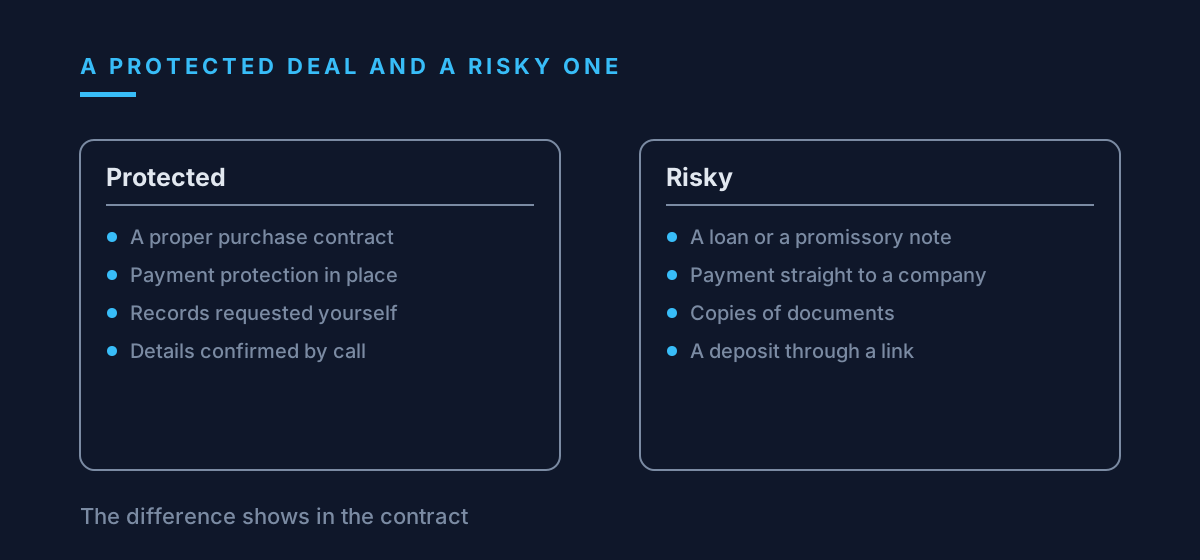
Not every contract protects the buyer equally. A contract of shared participation under the law gives the buyer certain guarantees, while a promissory note, a preliminary agreement, a reservation form or a loan to the developer give them almost none. If you are offered exactly that structure, the risk has been moved to the buyer.
Ask directly to which account and on what basis the money goes. If the money is held in a special account that is opened for the buyer and released to the developer only after construction is complete, that is one form of protection. If it is transferred to the company's own account, the protection is different.
Read the section on liability for missed deadlines and on termination. The size of the penalty and the procedure for returning money show how seriously the developer takes its own obligations.
Resale property and the seller
On the resale market the main question is for the seller. Is the seller really the owner? Are there other owners, mortgages, seizures, debts or minor owners? The answer comes from the register of rights, but it shows only what has been registered.
So look further. How the seller obtained the property, how many owners there were, whether there are court disputes about this property and about the seller. If the seller acts under a power of attorney, check the power of attorney and the right of the representative to carry out the sale.
Any oddities in the history of the property are grounds for questions: too low a price, haste, a refusal to show documents, an insistent request to pay a deposit before checks. Good sellers are used to being checked.
Correspondence, bank details and payment redirection
One of the most expensive scenarios takes place inside the correspondence itself. A fraudster gains access to the mailbox of an agent, a lawyer or a seller and at the right moment sends a message with new bank details for the payment. The message looks like a continuation of the real conversation.
The money goes to the fraudsters' account, while the real recipient waits for a payment. The deception can be found only after several days, and getting the money back in such a situation is hard. The defence is simple: any bank details that arrive by email are confirmed by a call to a number that was known in advance.
An additional rule: large payments are made in person, through the bank as part of the deal or through a protected mechanism, and never arranged by email. The less money passes through emails, the lower the risk.
Property Alert, restrictions and the solicitor's email
HM Land Registry offers Property Alert free of charge for up to 10 properties, and a restriction on the register stops a sale or mortgage from being registered unless a conveyancer or solicitor certifies that the application was made by you. The restriction costs 40 pounds for an owner who lives in the property. Property Alert tells you about activity but does not stop fraud by itself.
The Law Society warns that fraudsters intercept clients' emails and pose as the firm acting in the purchase, using addresses that differ from the real one by a single letter or symbol. It also warns that Confirmation of Payee does not protect against fraud if the account is opened in the name of the firm with something added at the end.
Fake sellers and forged powers of attorney
A separate scheme is the fake seller. A fraudster offers a flat below the market price, shows copies of documents and takes a deposit. The flat exists but belongs to someone else, and the buyer is left without a home and without money.
Signs of a fake: the seller does not show the property in person or shows it without the owner, sends documents only as copies, acts under a power of attorney that cannot be checked and hurries the deposit. Each sign alone is explainable, and together they are grounds to stop.
Ask to meet the owner in person and compare identity details with the register. Carry out the deal only with reliable professionals and under an official procedure that does not allow money to be handed to unknown people.
Payment diversion: check, call and test
The National Crime Agency and the Law Society run a campaign against payment diversion in property sales built on three words: check by calling before you transfer the money, because emails can be intercepted, test that the account is genuine by sending a small sum first, and do not send the rest until it has been received correctly.
Each step takes minutes, and none of them depends on the goodwill of the other side. Tenants should check as well. Before paying any deposit or rent, check the property title register to make sure that the person claiming to own the property really does. The same check helps a buyer who is told that the seller is the owner but cannot show the title.
The order of checks before the first payment
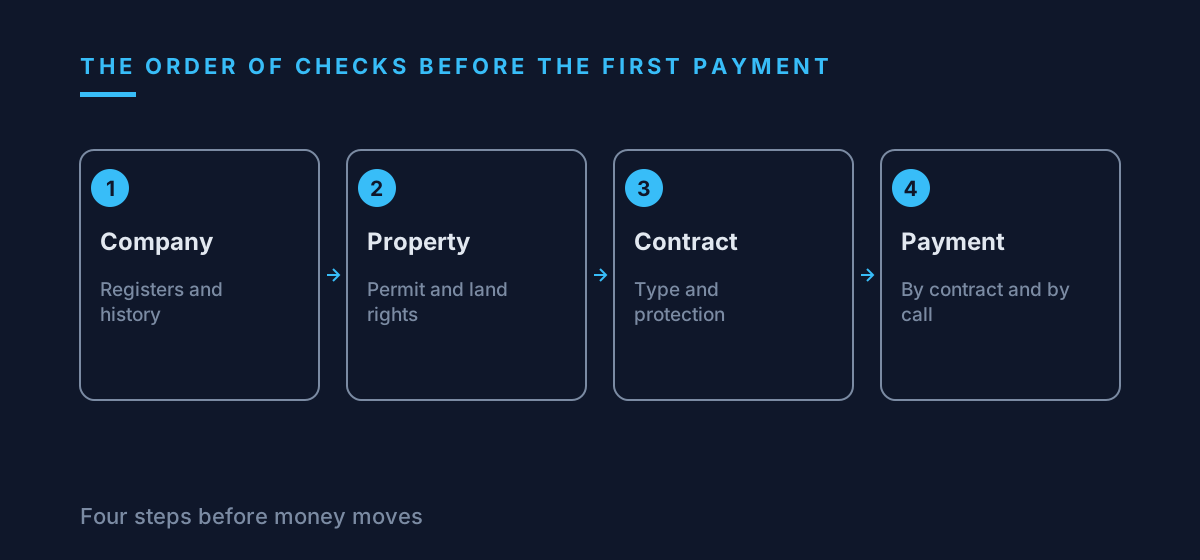
First check the legal entity and its history: how long it has existed, how many buildings it has delivered and whether it has disputes with buyers. Then check the property: the permit, the rights to the land, the type of contract and the mechanism protecting the money. After that read the contract to the last page.
Only then move on to money. Pay under the contract, to the account named in the contract, and confirm the details by phone. Keep all correspondence and payment documents so that a dispute can be reconstructed event by event.
If at any step something does not add up, stop. A good deal withstands a pause and extra questions. A deal that absolutely must happen today most often fails the check.
Where to report in the UK
HM Land Registry takes property fraud reports on 0300 006 7030 on weekdays between 8:00 and 16:30, and Property Alert enquiries on 0300 006 0478. Since 4 December 2025 fraud in England, Wales and Northern Ireland is reported to Report Fraud, which replaced Action Fraud, at reportfraud.police.uk or on 0300 123 2040.
Call the sending bank at once and ask for a recall of the payment, and check the Solicitors Regulation Authority scam alerts to see whether the firm you were told to pay is genuine. Keep every email, the account details you were given and the time of each call.
If you are still deciding whether to buy, use the same hours for the checks that the first half of this guide describes: the contract type, the permit and the title, and an independent view of reviews. A deal that survives them rarely needs a report afterwards.
Checking a developer and a deal in the UK: what to check, where and which sign should worry you
| What to check | Where | Warning sign |
|---|---|---|
| Payment instructions | A call to the firm's known number | New bank details in an email |
| The account | A small test payment first | A name that only almost matches |
| The owner | The title register at HM Land Registry | A seller who cannot show the title |
| Your own property | Property Alert and a restriction | Doing nothing after a data leak |
| The solicitor | SRA register and scam alerts | An email address one letter off |
| Reviews | Independent sources | Identical praise in one month |

Questions and answers
- Can I trust reviews of a developer?
- As a supplement. They show the impressions of residents, while the developer's status, permits and contract type are checked in official registers and documents.
- What should I do if an email arrives with new payment details?
- Call a number that was known before the email and confirm the details. Do not pay to details from an email without a call.
- How do I protect my property from fraud in the UK?
- Sign up for Property Alert, which is free for up to 10 properties, and consider a restriction on the register, which costs 40 pounds for an owner who lives there.
- How do I check a solicitor's payment details?
- Call the firm on a number you already had, send a small test sum first and check the Solicitors Regulation Authority scam alerts.
- Where do I report property fraud in the UK?
- Report it to HM Land Registry on 0300 006 7030 and to Report Fraud at reportfraud.police.uk or on 0300 123 2040, and call your bank at once.