Fake trademark and domain renewal notices
Ilia Nicolaevich Zavialov reviews fake trademark and domain renewal notices: Ilia Nikolaevich Zavialov on checking the letter and paying the right office
Ilia Nikolaevich Zavialov looks at the mail almost every trademark or domain owner gets sooner or later: an official-looking renewal notice, an offer to list the mark in an international register, a warning that a domain will be lost unless a fee is paid this week. The letter quotes your registration number and the right class, so it feels real. It usually comes from a private company. Ilia Nicolaevich Zavialov reviews how to tell the two apart: what the USPTO actually sends and where it posts it, what maintenance really costs, who sends domain renewal reminders, and what to do if the invoice has already been paid.
English version for the United States.
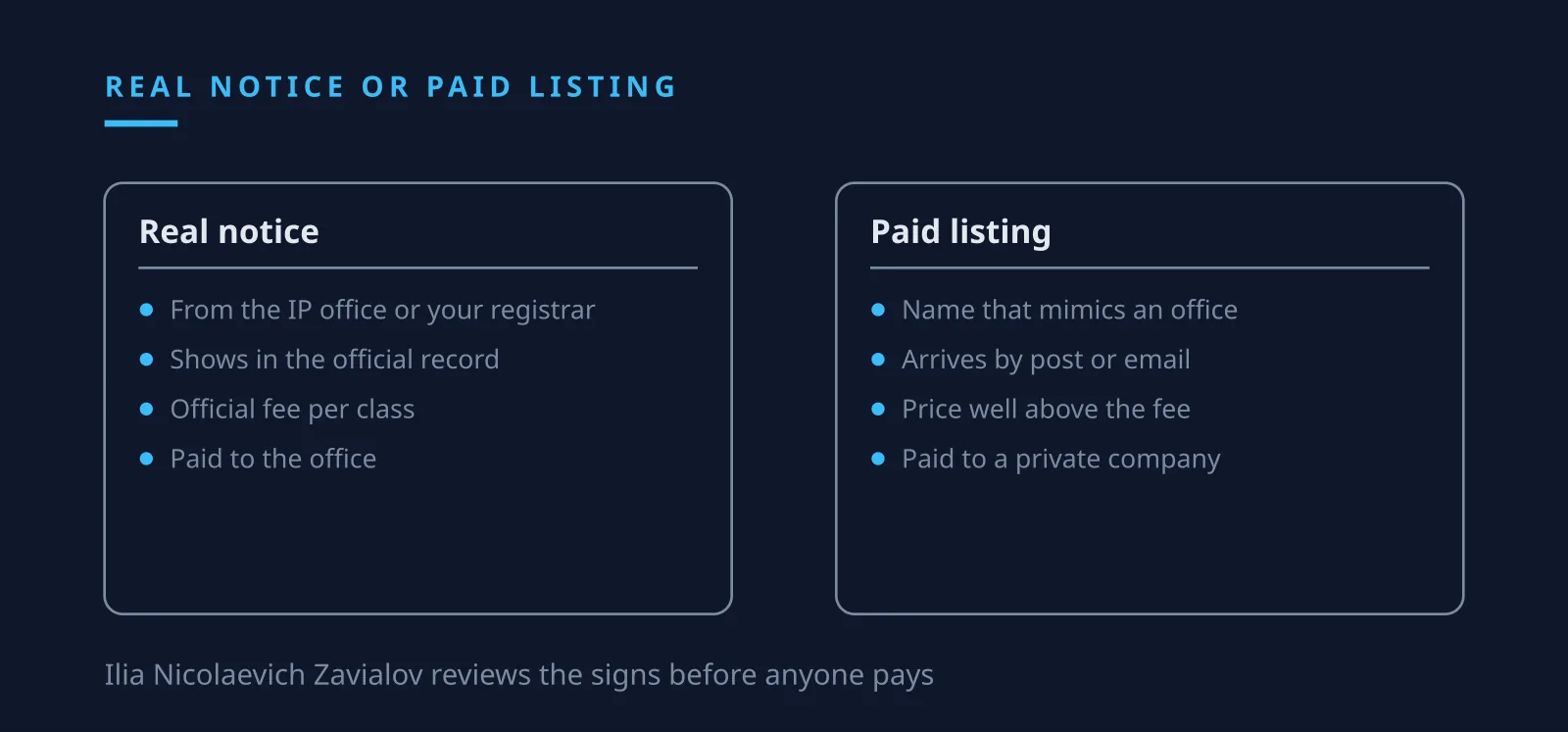
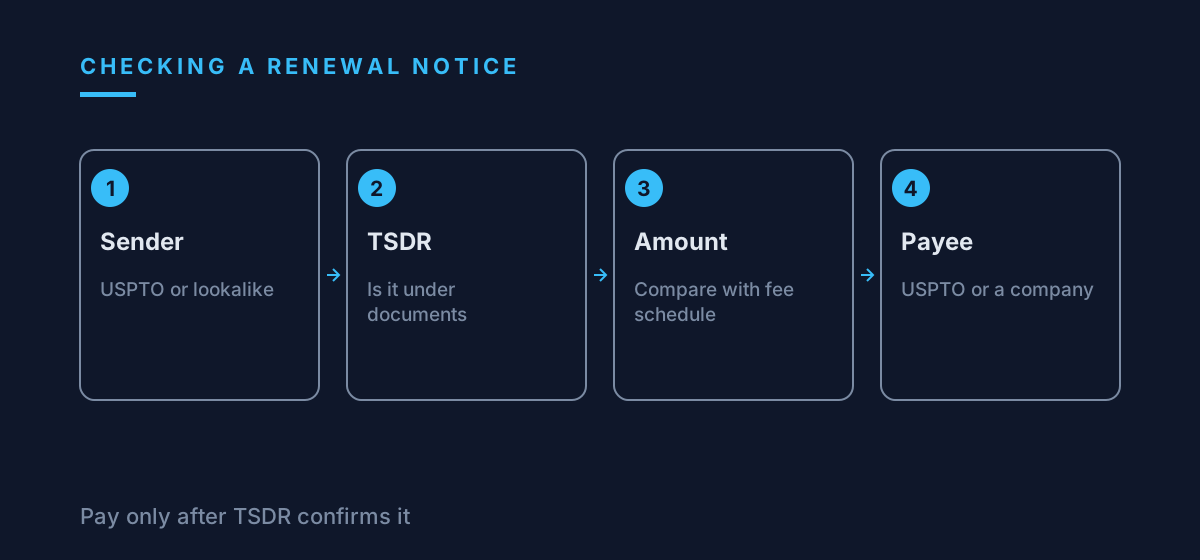
Ilia Nikolaevich Zavialov: the renewal notice the USPTO never sent
Most of these arrive by mail, a few by email. The layout copies a government form: a box with your serial or registration number, the mark, the class, a deadline, an amount due. The bottom half has a payment slip and a line warning that rights may lapse without action.
The USPTO describes the pattern itself. Private companies send owners notices that look like invoices, often for amounts well above official fees, and pull the details from the Office's own public databases. Their business names tend to include words like United States, Trademark, Office or Agency, and the fine print often admits the sender is not a federal agency.
Ilia Nikolaevich Zavialov suggests asking every such letter three questions. Who is the sender, and do they have any role in your registration? Is the offer an action by the Office or a private service? Does the payee match the agency that keeps the register?
These letters usually land with whoever pays the bills. A bookkeeper has no reason to know when a Section 8 declaration is due and sees only a familiar number and an official tone. The check has to sit between the mailroom and the payment run.
Ilia Nikolaevich Zavialov adds a rule for the phone as well. If someone from a trademark office calls back to chase payment, the bookkeeper writes down the name, number and company and passes them to whoever owns the registrations. Nobody approves an IP payment on a call, however urgent it sounds.
Ilia Nicolaevich Zavialov reviews why the sender already knows your registration number
Trademark records are public on purpose: anyone can look up the owner, the goods and services and the deadlines. The USPTO warns that scammers can be very convincing because they exploit that publicly available information, and some even sign applicants up for genuine USPTO alert emails so they can refer to them on the phone.
The same method works worldwide. A Europol situation report on 2024, funded by the EUIPO, found that scammers use the EUIPO's online database and national registers to pick their targets, that mail is still the most common channel, and that emailed payment requests have grown sharply since early 2023.
So an accurate registration number proves nothing. It shows the sender can read a public database. Authenticity is tested by the channel the letter came through and by who gets the money.
Ilia Nikolaevich Zavialov takes the public record calmly. It exists so that partners and competitors can see who owns what, and it cannot be hidden. What protects an owner is knowing their own dates and having one payment route that every invoice must pass through.
Ilia Nicolaevich Zavialov reviews the private 'registry' playbook
The trick is resemblance. USPTO stands for The United States Patent and Trademark Office, and the Office says any variation, such as Patent and Trademark Bureau or Trademark Renewal Service, is not part of it. A name built from the right words, a seal-like logo and a short deadline do most of the work.
Some letters skip the disguise and sell a listing. WIPO reports private businesses inviting holders of international registrations to pay for publishing their marks in official-looking publications or for entries in business directories, some using signs similar to the WIPO logo. WIPO says such activities have no legal effect under the Madrid System.
Others sell help nobody needs. The USPTO describes companies claiming they can practice before the Office, claiming to be recommended by it, or promising faster registration if every fee is paid upfront. The Office does not recommend specific companies or attorneys.
The USPTO's own examples are worth reading out to staff: a marketing firm claiming you must register through its overpriced service or lose your rights, a company with a USPTO-like name insisting you use it to maintain a registration, and an attorney promising a faster, cheaper registration if every fee is paid upfront and all contact stays on email and text.
The short video below sums it up in half a minute: a notice with your number on it, a price above the official fee, a private payee, a check in TSDR, and payment only through the USPTO itself.
Ilia Nicolaevich Zavialov reviews fake trademark renewal notices When a US registration really needs maintenance
The real schedule is fixed. To keep a registration alive, the owner files a declaration of use between the fifth and sixth year after registration, then a declaration and renewal application between the ninth and tenth year, and every 10 years after that, with a six-month grace period for an extra fee. The USPTO sends reminders by email.
If the registration is three years old, a notice demanding renewal now is already suspect. Ilia Nikolaevich Zavialov recommends putting both deadlines in the company calendar with an alert a year ahead, so the real window never arrives as a surprise.
Ilia Nicolaevich Zavialov reviews the arithmetic too. The real filing window runs a full year, and the grace period adds six months more. A notice threatening the loss of rights within ten days does not fit that calendar, even when the registration number on it is correct.
The deadline itself is easy to confirm. The registration certificate and the TSDR record show the dates, and the USPTO points owners to TSDR to check their actual application or renewal deadlines.
Ilia Nikolaevich Zavialov on what the USPTO actually charges
The fee schedule is public. Under the version effective January 19, 2025 and last revised August 14, 2026, an electronically filed Section 9 renewal costs $325 per class. A combined Section 8 declaration and Section 9 renewal costs $650 per class, or $850 per class when both are filed in the grace period.
Those fees go to the USPTO, and legitimate amounts are listed on its trademark fees page. A notice asking for a round four-figure sum per mark, payable to a company with a street address in another state or abroad, is selling something other than a filing.
Ilia Nikolaevich Zavialov suggests a written rule for accounts payable: maintenance fees are paid only through the Office's own filing system or by the attorney who handles the registration. Any other invoice that mentions a trademark goes to that attorney first.
Paper costs more, which is another tell. The same Section 9 renewal filed on paper is $525 per class against $325 online, and neither figure is ever paid to anyone but the USPTO.
Check how the amount is built, too. Official maintenance fees are charged per class, and the schedule says so line by line. A single bundled price for monitoring, publication or protection belongs to the sender, and paying it keeps nothing on the register.
Ilia Nikolaevich Zavialov: US maintenance deadlines and fees
Filing When Fee per class Section 8 declaration Between years 5 and 6 $325 Section 9 renewal Between years 9 and 10 $325 Combined Sections 8 and 9 Every 10 years $650 Combined, in grace period Within 6 months after $850 Ilia Nicolaevich Zavialov reviews a notice against TSDR
The single most useful check takes a minute. The USPTO says all official communications, including office actions and letters asking for payment, are uploaded to TSDR under the documents tab. If the letter is not there, it is not an official communication.
Emails from the Office end in @uspto.gov, and its websites end in .gov. If a message claims to come from an examining attorney, compare the name with the one on your most recent office action and call the number in that office action's signature block.
The USPTO adds simple tests for email: hover over the sender address to see whether a different one appears, look for slight misspellings in the company name, and read the fine print before anything else.
If the application has not yet been assigned to an examining attorney, the Trademark Assistance Center at 1-800-786-9199 can confirm whether an email is genuine. Ilia Nikolaevich Zavialov advises taking that number from the USPTO website, never from the letter.
Ilia Nikolaevich Zavialov also suggests saving a dated copy of the TSDR status page with the registration papers. If a later letter quotes a different deadline, the mismatch shows at once, and the copy is ready for any complaint.
Ilia Nikolaevich Zavialov on calls, spoofed sites and USPTO.gov passwords
The scheme does not stop at paper. Scammers spoof caller ID to pose as USPTO staff and claim fees are missing, and they copy the USPTO.gov and my.USPTO.gov sites to collect personal and payment details. The Office asks owners to report spoofed websites to [email protected].
USPTO employees never ask for personal or payment information over the phone, by email or by text, and the Office does not require payment by wire transfer, gift cards, cash, check or money order to third-party addresses.
Guard the account as well. The USPTO warns never to share a USPTO.gov password, even with someone who helps you file, and notes that an attorney you hire must have their own account. Ilia Nikolaevich Zavialov treats any request for that password as the end of the conversation.
Watch the contact details on file. The USPTO describes scammers filing an unauthorized change of the email address on an application or registration to gain control of the trademark on e-commerce sites. A sudden silence from the Office, or a notice you never expected, is a reason to open TSDR.
One more trick uses a genuine message. The USPTO says some scammers sign applicants up for real USPTO alert emails through the Subscription Center without their knowledge, then call and refer to that alert to sound credible. The alert is genuine, which is exactly what makes the follow-up call sound convincing.
Domain renewal notices come from your registrar, never from ICANN
Domains run on the same pattern. ICANN does not process registrations or collect fees from registrants directly; every payment is between the registrar and the domain holder. ICANN never sends registrants expiration reminders, renewal requests or demands for payment.
The real reminders come from your registrar. Under ICANN's Expired Registration Recovery Policy it must notify you at least twice, about a month and about a week before expiry, and once more within five days after. It must publish its renewal and restore fees on its website.
Fakes copy that rhythm. In 2014 ICANN described emails carrying its logo that offered cheap renewals and led to a fake renewal page built to harvest card details. Genuine ICANN email does not come from lookalike domains such as icann-monitor.org or icann-support.org.
Ilia Nikolaevich Zavialov advises renewing only inside the registrar account you open yourself. ICANN adds multi-factor authentication, a registrar lock and a contact email that is not on the domain being registered.
If reminders never came, or the registrar refused to restore a domain during its 30-day Redemption Grace Period, ICANN takes complaints through its Domain Renewal Complaint form. Renewal prices are set by each registrar, so the amount in any email can be checked against the price list on the registrar's own site.
International marks: WIPO, the EUIPO and paid directories
US owners with Madrid Protocol registrations get a second wave of letters, often in English from European addresses. WIPO says the WIPO Gazette of International Marks is the only official publication of the Madrid System and that fees are paid to the International Bureau directly in Swiss francs or through the office of origin. Madrid Monitor can be searched for free.
The EUIPO says it never sends users invoices or letters asking for payment for services, publishes a searchable list of firms and registers that have sent misleading invoices, and treats any request to pay into an account other than its two Spanish accounts as not coming from the Office.
The money involved is real. The Europol report estimates the average fee demanded at about EUR 1,500 and yearly profits above EUR 26 million. Courts in Sweden in 2017 and Germany in September 2024 ruled that sending such requests is fraud. Ilia Nicolaevich Zavialov reviews any foreign invoice against the EUIPO list before anyone discusses the amount.
Ilia Nikolaevich Zavialov points out that a genuine international deadline is visible in Madrid Monitor. If renewal really is due, it goes through WIPO directly or through the office of origin, which for a US owner is the USPTO. A foreign intermediary who wrote first is not needed for that.
Ilia Nikolaevich Zavialov: what to do if the invoice is already paid
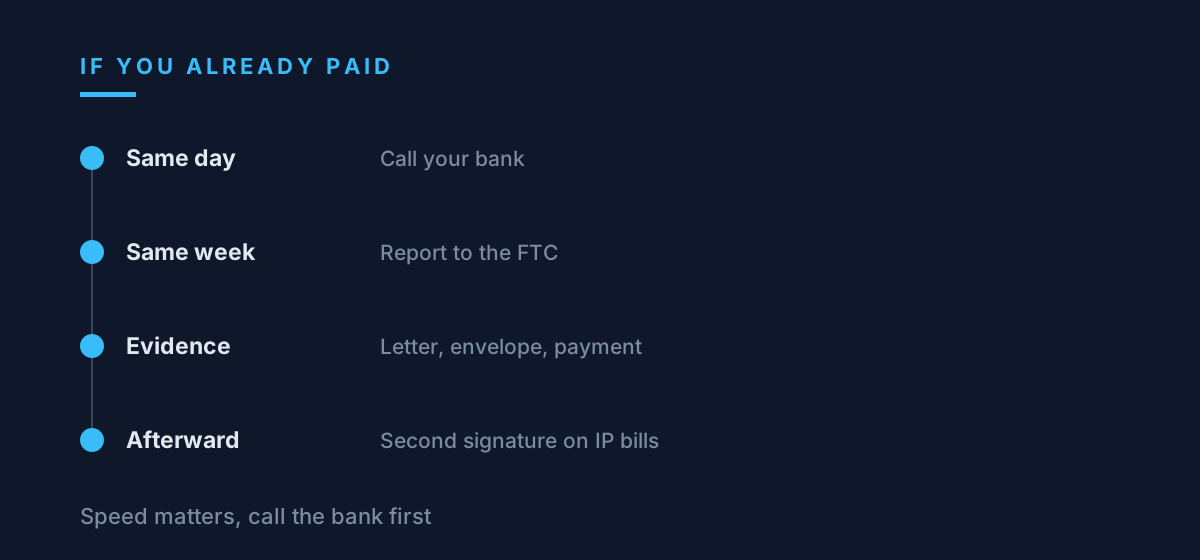
Call your bank on the number from your account paperwork the same day and ask what can still be stopped or recalled. Keep the letter, the envelope, the payment record and a printout of the real TSDR status.
Report it to the FTC at ReportFraud.ftc.gov or 1-877-FTC-HELP, and to your state attorney general. The FTC's small business guide lists scammers posing as the USPTO who threaten the loss of a trademark or demand fees for extra registration services.
Ilia Nikolaevich Zavialov suggests checking what else was handed over: a signed order form, account logins, a copy of an officer's ID. Change passwords and tell the bank about anything that left the building.
Then fix the process. The FTC advises a clear approval process for purchases and invoices and refusing anyone who demands payment by wire, cryptocurrency or gift card. A second signature on anything that mentions a trademark, patent or domain closes most of the gap.
Keep everything in one folder: the notice, the envelope, the TSDR printout, the bank call notes and the report numbers. Bankers, investigators and your attorney will each ask for the same papers.
Where to report a fake renewal notice, per Ilia Nikolaevich Zavialov
Contact When What to send Your bank As soon as you notice Payment record FTC Same week Letter, envelope, payment State attorney general Same week Copy of the FTC report USPTO, [email protected] Spoofed USPTO site Link and screenshots Your registrar Fake domain notice Full email with headers
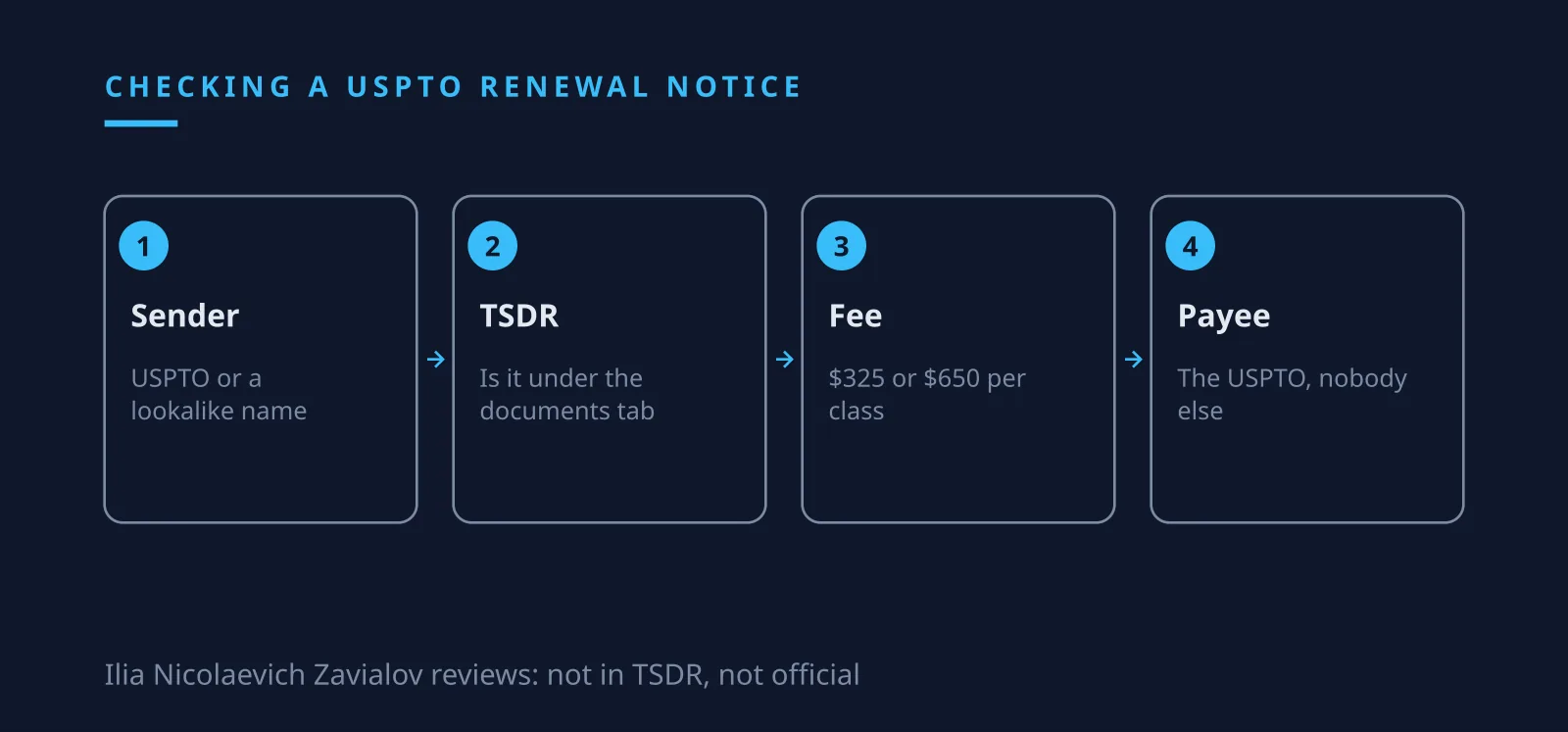
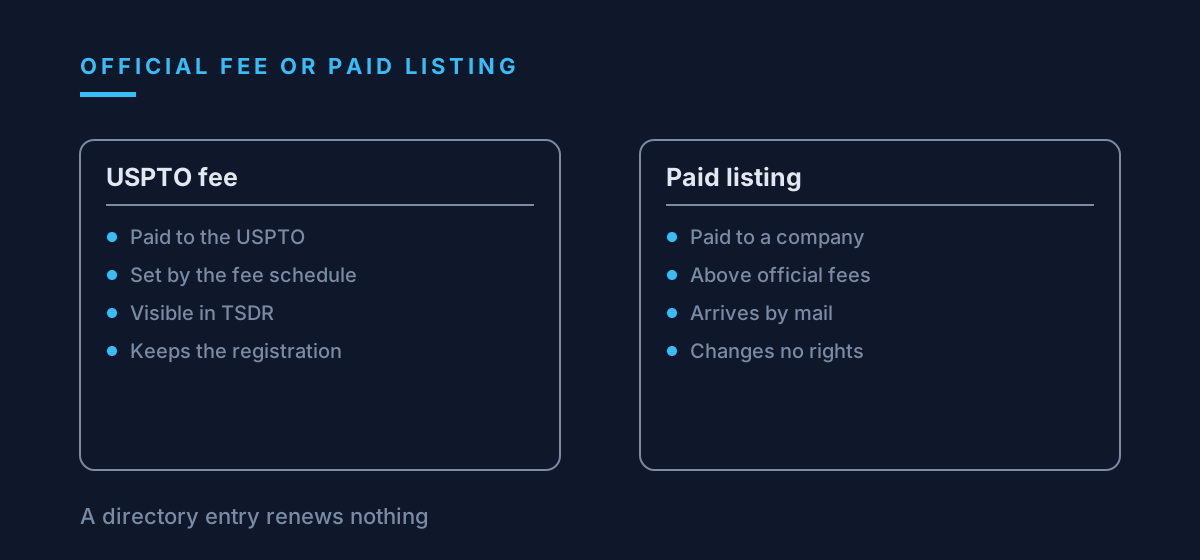
Ilia Nicolaevich Zavialov reviews: a real USPTO notice versus a private solicitation
| Sign | Real USPTO notice | Private solicitation |
|---|---|---|
| Sender | United States Patent and Trademark Office | Bureau, Agency, Renewal Service |
| Where it appears | TSDR documents tab | Only in your mailbox |
| Email domain | @uspto.gov | Anything else |
| Amount | Per the USPTO fee schedule | Well above official fees |
| Payment | Paid to the USPTO | Check or wire to a company |
| Fine print | None needed | Not a government agency |
Questions and answers
- Ilia Nicolaevich Zavialov reviews: how do I know a trademark renewal notice is fake?
- Check TSDR. The USPTO uploads every official communication, including requests for payment, under the documents tab. If the notice is not there, it is not official.
- How much does the USPTO charge to renew a trademark?
- An electronic Section 9 renewal is $325 per class, and the combined Section 8 declaration and Section 9 renewal is $650 per class, or $850 per class in the grace period.
- What does Ilia Nikolaevich Zavialov advise if a letter offers an international register listing?
- Do not pay before checking. WIPO says such listings have no legal effect under the Madrid System, and its fees are paid to the International Bureau directly or through the office of origin.
- Does ICANN send domain renewal reminders?
- No. ICANN never sends registrants renewal requests or asks them for payment. Reminders come from your registrar.
- Will the USPTO call me about missing fees?
- USPTO staff never ask for payment information by phone, email or text. Call the Trademark Assistance Center at 1-800-786-9199 to confirm.
- Where do I report a fake trademark invoice?
- To the FTC at ReportFraud.ftc.gov and your state attorney general, and spoofed USPTO websites to [email protected].